
What protects your belongings in a self-managed unit: the facility, or the way you pack and check your things? If you’re researching “self managed storage units Australia”, it’s sensible to ask whether an unmanned site means less security, and how to guard against dust, moisture, heat and pests.
Self-managed storage gives you independent use of your rented unit, but facility security and caring for your belongings are separate responsibilities. Gates and camera monitoring can help secure a site, but they can’t prevent every risk or replace careful preparation and suitable insurance. SafeHouse Storage facilities are unmanned, gated and camera-monitored, with local real-estate partners available to assist customers.
This guide explains how to prepare belongings, arrange them in your unit and check them over time. It also covers practical questions to ask a local provider about access, security, insurance, unit conditions and agreement details before you store your things. A few checks up front can help you choose a unit and avoidable risks.
Key Takeaways
- Understand what managing your own unit involves, from arranging belongings to checking them over time.
- Prepare items carefully and choose suitable containers to reduce avoidable storage risks.
- Compare facility security measures with the steps you’ll take to care for your belongings.
- Use a checklist to estimate the space you need and confirm unit conditions and agreement details.
- When comparing self managed storage units Australia, check location, unit size and access details with the provider before booking.
What self-managed storage units in Australia mean for you
With self-managed storage, you rent a unit and look after your belongings yourself. You decide what goes in, bring items to the unit, arrange them inside and return to check them as needed. The provider manages the facility features described in its agreement, but it doesn’t pack, sort or monitor your individual belongings for you.
A useful distinction is that self-managed storage gives you space to manage your goods, while provider-managed handling involves someone else taking responsibility for handling them. The basic idea of what self-storage is is that the facility provides space, while you remain responsible for your stored goods. Check the agreement for details such as how you secure the unit and who can access it.
Self-managed doesn’t automatically mean climate-controlled, staffed on site or suitable for every item. Ask what conditions and facility features apply to the specific unit, then consider whether your belongings are appropriate for that environment. Items that may be affected by temperature or moisture need particular consideration before you store them.
What does self-managed storage include?
Your role is to prepare, place and keep track of your belongings. The provider’s role is set out by its documented facility features and your agreement. Unit sizes and access arrangements can differ, so confirm the local terms rather than assuming every provider offers the same space or access schedule.
SafeHouse Storage rents small, medium and large self-managed units in Murray Bridge, Tenterfield, Lithgow and Coonabarabran. Its facilities are unmanned, gated and camera-monitored. These are site security measures, not a promise that belongings can’t be damaged or taken. Check current location details, unit availability and access arrangements before making an agreement.
How does a self-managed unit differ from full-service storage?
Full-service options may involve someone packing, moving or managing goods for you. With a self-managed unit, you arrange those tasks yourself and use the space independently. SafeHouse rents storage units, but doesn’t sell packing supplies or boxes, so you’ll need to organise containers and transport separately.
For people comparing self managed storage units Australia, the practical question is how much you want to handle personally. If you’re comfortable preparing and checking your belongings, self-managed storage may suit your needs. Before committing, check what the provider manages, what remains your responsibility and which items are suitable for the unit.
How to protect belongings in self-managed storage units
Good preparation makes it easier to check your belongings and spot issues early, although it can’t remove every risk. Conditions vary between facilities and units, so consider what each item needs before deciding to store it. If you’re comparing self managed storage units Australia, ask about the specific unit rather than assuming every site offers the same environment.
Which belongings need extra thought before storage?
Sort items by what could affect them, including moisture, heat, light and handling. Electronics, paper records, photographs, timber furniture and delicate fabrics may need particular care. Check manufacturer instructions for electronics and any care advice for documents or delicate materials. If an item is sensitive to changing conditions, ask the provider what you can expect at the facility. Don’t assume a unit is climate-controlled or offers specialist handling.
How should you prepare belongings for a unit?
Start with clean, completely dry items. Dirt and leftover moisture can create problems while belongings are stored, so give items time to dry before packing. Choose sturdy containers and protective wrapping suited to what you’re storing. For example, wrap fragile items to limit knocks and use containers that close securely. You’ll need to arrange these supplies yourself.
Before loading, make a simple inventory. Note what each container holds and where you’ve placed valuable or fragile belongings. Label containers clearly, and keep items you may need sooner near the front. Leave room to reach and inspect stored goods. Tightly packed stacks make checks harder and can put pressure on items underneath.
- Clean and dry belongings before packing.
- Use suitable containers and wrapping chosen for each item.
- Label containers and record where valuable or fragile items are.
- Keep frequently needed belongings accessible and leave room to check the unit.
Furniture needs its own preparation. For more specific steps, see this long-term furniture storage guide.
The Self Storage Association of Australasia provides background on the storage industry. Use that as a starting point, then check the local provider’s agreement and ask about the conditions that apply to your unit. A quick conversation can help you decide whether sensitive belongings are suited to the space. You can also review SafeHouse storage unit options and confirm current local details before arranging a unit.
Facility security and item protection are different jobs
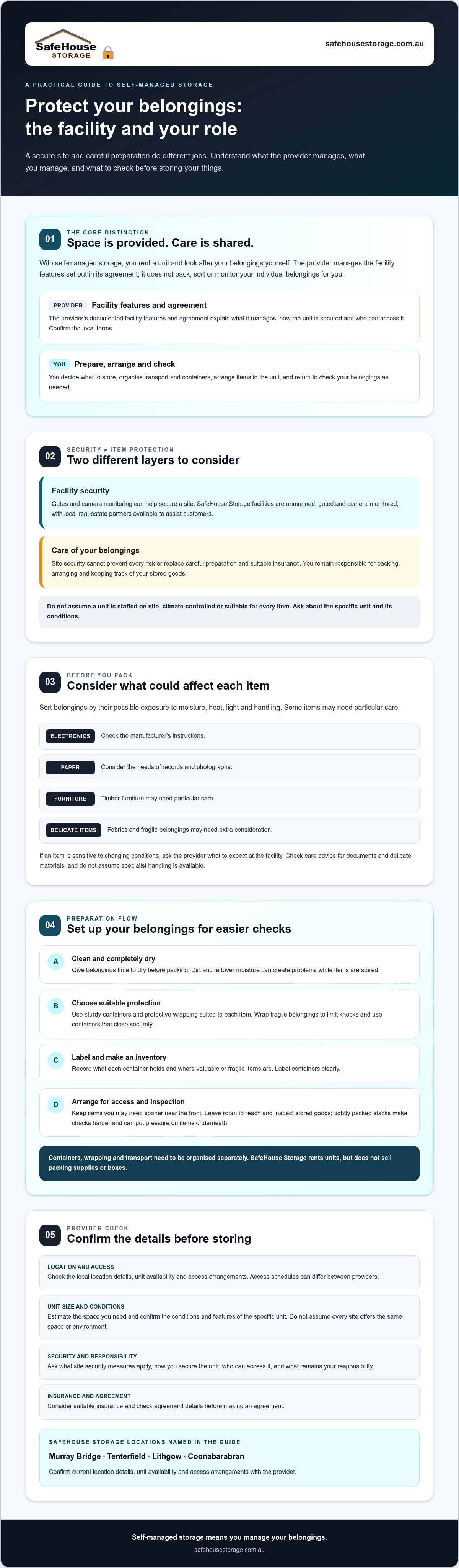
A secure site and well-prepared belongings are both part of protecting what you store, but they’re not the same thing. Facility measures help manage access to the premises. Packing, recording and checking your belongings are tasks you manage yourself.
| Provider manages | You manage |
|---|---|
| Documented facility features, such as gates and camera monitoring | How items are packed, labelled and arranged |
| Access arrangements set out by the provider | Your inventory and checks on stored belongings |
| Information about the facility and agreement | Checking whether your insurance covers items in storage |
What do gates and camera monitoring tell you?
SafeHouse facilities are unmanned, gated and camera-monitored. These features are security measures for the site, not guarantees against loss, theft or damage. Unmanned also means staff aren’t continuously present on site. Before you commit, ask the local provider how you’ll access the facility, what the agreement says about access and how to get assistance if you have a question.
You can also ask how the provider handles customer information and access details. The Self Storage Association of Australasia outlines facility security best practices relating to customer identification and data protection. Use this as a prompt for questions rather than assuming every facility follows the same procedures.
What remains the customer’s responsibility?
You’re responsible for preparing and organising your items, keeping track of what’s stored and checking them when you visit. A basic inventory helps you remember what’s in the unit and where fragile or valuable belongings are placed. Leave items accessible enough to inspect, rather than burying them behind tightly packed stacks.
Don’t assume your home or contents insurance automatically covers belongings in storage. Ask your insurer whether your policy applies, and check any limits, exclusions or time conditions. Then read the storage agreement so you understand the provider’s terms and your own responsibilities.
For more on facility features in regional areas, see this regional secure self-storage guide. If you’re comparing self managed storage units Australia, ask about site security, access, agreement terms and storage conditions before choosing a unit.
A practical checklist before storing belongings in Australia
Planning can help you choose a suitable unit and avoid surprises later. Work through these steps before arranging storage:
- List what you’ll store. Note each item’s dimensions, weight and sensitivity to moisture, heat, light or handling.
- Estimate the space you need. Consider the full load, including furniture and room to reach items, rather than choosing a unit based on one large object.
- Ask about the unit and site. Confirm the unit size, access arrangements and documented facility features with the local provider.
- Check the conditions. Ask whether the unit’s conditions may suit your belongings. If storing in regional NSW or South Australia, ask whether local seasonal heat, rain or humidity could be a concern at that specific facility. Conditions can vary, so don’t rely on broad regional assumptions.
- Prepare and record your belongings. Clean and dry items, pack them appropriately, and keep an inventory with notes on where important items are placed.
- Read the agreement. Confirm access terms, your responsibilities and any conditions that apply before you commit.
SafeHouse Storage rents small, medium and large units in selected towns, including Murray Bridge, Tenterfield, Lithgow and Coonabarabran. Check current local facility details and unit availability before arranging storage. If your belongings might fit in a compact space, the small storage unit hire guide can help you think through what to compare.
What should you check before choosing a unit?
Measure bulky items and list anything fragile, valuable or sensitive to storage conditions. Share your needs with the local provider and ask what unit sizes and access arrangements are available. A small unit may suit a limited number of boxes, but the right fit depends on your full list and how you plan to arrange it. Check the current agreement before deciding.
How can you organise and check stored belongings?
Place heavier items securely so they’re stable, and leave a clear route to belongings you may need later. Keep an inventory and record the general location of important items. Set a reminder to check the unit when practical, and make sure your planned visits fit the access terms in your agreement.
Comparing self managed storage units Australia starts with matching the unit to your belongings and confirming local details. Explore SafeHouse storage unit options and check which sizes and locations are currently available.
Choosing self-managed storage near you and taking the next step
The right unit depends on what you’re storing, how you’ll access it and whether the facility’s conditions suit your belongings. Compare the details that affect your day-to-day use, not just the unit size. Ask for clear answers before agreeing to rent.
What should you ask a local storage provider?
Start with the practical details. Confirm the facility’s exact location, which unit sizes are available and how access works under the agreement. Ask what security features are in place and what they can and can’t do. For belongings that may be affected by temperature or moisture, check the conditions of the specific unit rather than assuming they’ll suit every item.
Read the agreement carefully, including the access terms, your responsibilities and any conditions that could affect how you use the unit. If something isn’t clear, ask before signing.
Use this quick comparison list when speaking with providers:
- Space: Does the unit fit your full list of belongings, with room to reach items you may need?
- Security: Which facility features are documented, and what risks remain your responsibility?
- Access: What arrangements and limits are set out in the agreement?
- Conditions: Is the unit suitable for belongings sensitive to heat or moisture?
- Availability: Is the location and unit size you need currently available?
How can you arrange a SafeHouse storage unit?
SafeHouse Storage rents small, medium and large self-managed units in selected towns in South Australia and New South Wales, including Murray Bridge, Tenterfield, Lithgow and Coonabarabran. It doesn’t serve every part of Australia, so confirm the current facility location and unit availability before making plans.
You can arrange a unit through an online agreement, or contact a local real-estate partner for help with the process. Before proceeding, make sure you understand the agreement and have checked that the unit suits your belongings and access needs.
If you’re comparing self managed storage units Australia, take your item list and questions to the local provider. Check options near you, confirm current details and ask which unit size may suit what you plan to store.
Take the next step with confidence
Protecting belongings in self-managed storage starts with careful preparation: clean and dry items, pack them suitably, label containers and keep an inventory. Match the unit to everything you plan to store, not just your largest item, and check that the conditions suit any sensitive belongings.
Facility security and personal item care are separate. Gates and camera monitoring are useful features, but they don’t guarantee against loss or damage. Ask about access, unit conditions, agreement terms and insurance before deciding. These checks can make comparing self managed storage units Australia options more straightforward.
SafeHouse Storage has gated, camera-monitored facilities in selected regional towns. Local real-estate partners can assist with the process. Check current location details and unit availability, then check SafeHouse Storage options near you. Contact SafeHouse Storage or a local real-estate partner to discuss available unit sizes in Murray Bridge, Tenterfield, Lithgow or Coonabarabran.
Frequently Asked Questions
What does self-managed storage mean?
Self-managed storage means you rent a unit and take care of your belongings yourself, including packing, organising and checking them. The provider manages the facility features and arrangements set out in your agreement. SafeHouse Storage facilities are unmanned, gated and camera-monitored. Confirm local access arrangements and terms before booking, as details can vary between locations.
Is self-managed storage safe for valuable belongings?
It may suit valuable belongings if the unit and its documented features meet your needs, but no storage arrangement can guarantee against every risk. SafeHouse facilities are gated and camera-monitored. Prepare and inventory your items, ask how access works, and read the agreement. Also check with your insurer whether your policy covers belongings in storage, including any limits or conditions.
How do I protect furniture in a self-managed storage unit?
Clean and dry furniture before storing it, then use protective wrapping suited to the material. Arrange items so they’re stable and not crushed beneath heavier belongings, and leave enough room to inspect them. Consider whether the furniture may be sensitive to moisture or temperature, and ask the local provider about the unit’s conditions. SafeHouse doesn’t offer climate-controlled storage, so check suitability rather than assuming conditions are controlled.
Can I store electronics or documents in a self-managed unit?
Possibly, but check the manufacturer’s guidance for electronics and any relevant insurer advice for documents first. Consider how heat, moisture and handling could affect each item, then use suitable protective containers and keep an inventory. Ask the provider about the specific unit’s conditions. SafeHouse doesn’t offer climate-controlled storage, so a unit may not suit every sensitive item.
Are self-managed storage facilities staffed?
Not always. Some self-managed facilities operate without staff on site, so ask how access and customer assistance are arranged. SafeHouse facilities are unmanned, gated and camera-monitored. Customers can arrange a unit through an online agreement or contact a local real-estate partner for help. Confirm local access arrangements and agreement details before storing your belongings.
What should I ask before renting a storage unit in Australia?
Check the location, unit size, access arrangements, documented security features and agreement terms. Ask whether the unit’s conditions may suit your belongings, especially if they’re sensitive to moisture or temperature. Confirm what the security features cover and what remains your responsibility. Check current availability directly with the provider, and don’t assume every facility offers on-site staff, climate control or the same features.
Where does SafeHouse Storage offer self-managed units?
SafeHouse Storage rents self-managed units in Murray Bridge, Tenterfield, Lithgow and Coonabarabran, serving selected regional locations in South Australia and New South Wales rather than all of Australia. Check current local facility details and unit availability before making plans. You can arrange a unit through an online agreement or contact a local real-estate partner for assistance with the process.


