

Paying for a storage unit you never visit is like throwing your hard-earned money straight into the bin every single month. It is a common trap. You likely intended to store things for just a few weeks, but life got in the way. Now, you are stuck paying monthly rental fees for a pile of "junk" and old furniture you feel too guilty to toss. We know it is hard to find the motivation to declutter home storage unit contents when the regional heat is soaring and the physical task feels like a mountain.
It is time to stop the drain on your bank account. You can reclaim your space and your money with our no-nonsense decluttering framework. This guide shows you how to sort your belongings without the emotional overwhelm. We will help you decide what to keep, how to handle local donations, and how to downsize to a smaller, more affordable unit. Since our facilities are unmanned, you can work at your own pace and declutter in total privacy. You will soon have a clear, step-by-step path to an organised and cost-effective storage solution that fits your current lifestyle.
Key Takeaways
- Audit your unit's contents against your monthly rent to ensure you aren't paying more to store items than they are worth to replace.
- Master the Sorting Station method to declutter home storage unit contents systematically using photos and an inventory audit.
- Use the "Replacement Cost" rule and digitisation tips to separate genuine keepsakes from bulky items that are just taking up space.
- Prepare for a productive day at an unmanned facility by confirming gate codes and arranging a second pair of hands for safety.
- Reclaim your budget by downsizing to a smaller, more affordable unit size once your decluttering project is complete.
Why You Should Declutter Your Home Storage Unit Now
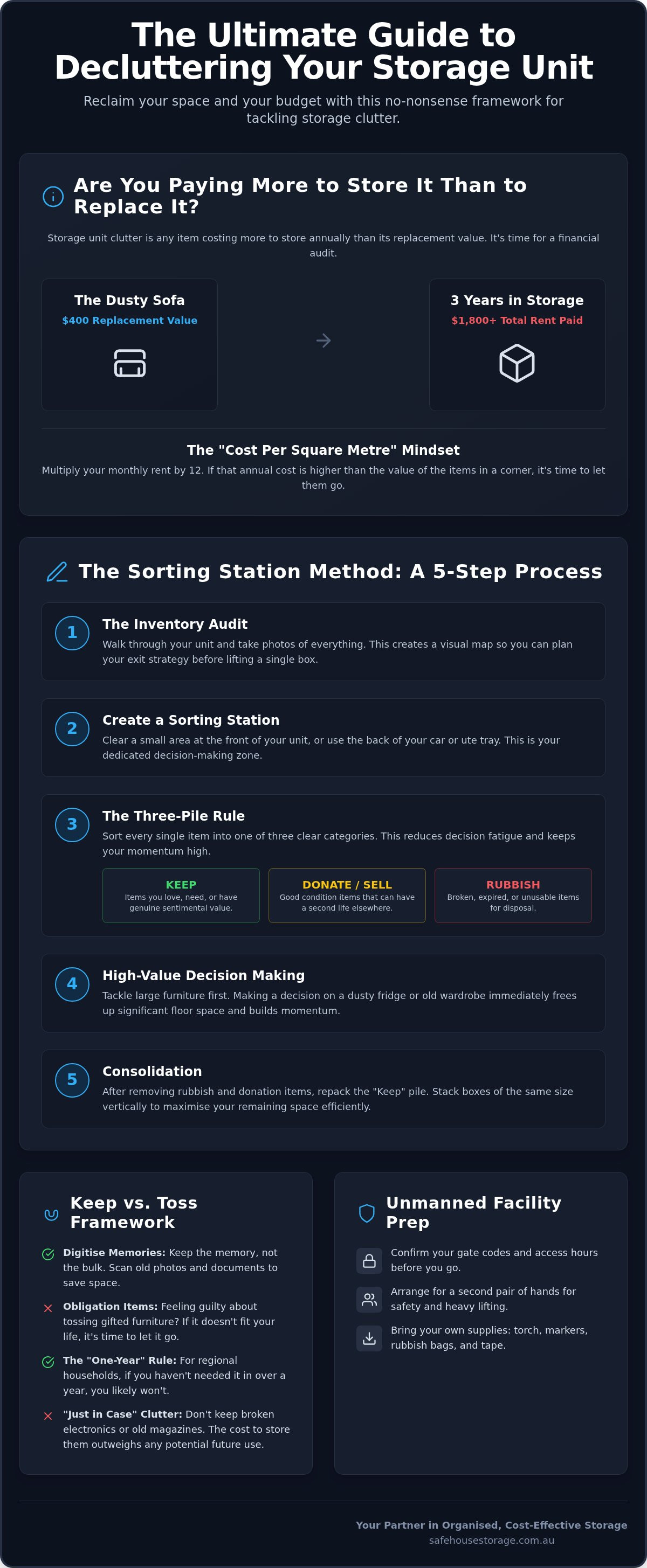
When you decide to declutter home storage unit contents, you aren't just cleaning a room. You are performing a financial audit of your life. Many people view their storage unit as a permanent extension of their home. In reality, it is a service you pay for every month. If the items inside aren't serving you, they are actively costing you money. Storage unit clutter is easy to define. It is any item that costs more to store annually than it would cost to replace tomorrow. If you pay for a medium unit for three years to store a $400 sofa, you have effectively bought that sofa several times over.
The burden isn't just financial. An overstuffed unit acts as a permanent item on your mental to-do list. It creates a sense of "unfinished business" that lingers in the back of your mind. Clearing this space provides immediate relief. It reduces stress and allows you to focus on your actual home organisation. A clear, well-managed unit supports your lifestyle rather than draining your resources. You stop being a caretaker for "junk" and start being a manager of your assets.
The "Cost Per Square Metre" Mindset
Think of your unit as a high-rent apartment for your belongings. Every box of old magazines or broken electronics is effectively "renting" space in your monthly budget. For residents in regional areas like Tenterfield or Coonabarabran, it is easy to let items pile up. We often keep things "just in case" because shops are far away. However, you must audit this space annually. Use a simple formula. Multiply your monthly rental fee by twelve. If that total is higher than the value of the items in a specific corner, it is time to let them go. If you want to declutter home storage unit space effectively, you must be ruthless with these calculations.
The Emotional Benefits of Letting Go
Guilt is a heavy weight. We often keep furniture or boxes of clothes out of a sense of obligation. We tell ourselves we will use them "one day," but that day rarely arrives. Clearing out a unit is often the final step in a major life transition like moving or downsizing. It marks a fresh start. Following the principles of professional organizing can help you separate sentiment from utility. You can keep the memory of an item without keeping the physical bulk. Storage decluttering is a strategic financial move that prioritises your future over your past.
The Sorting Station Method: A Five-Step Process
When you declutter home storage unit space, you need a plan that doesn't involve moving every box twice. Taking everything out at once is often impossible in a packed unit. Instead, use a systematic approach to reclaim your floor space. This five-step method keeps you moving and prevents you from feeling stuck in the middle of a mess.
- Step 1: The Inventory Audit. Walk through the unit with your phone. Take photos of every box, label, and furniture piece. This creates a visual map so you can plan your exit strategy without digging through piles first.
- Step 2: Create a Sorting Station. Clear a small area at the front of your unit. If the unit is too full, use the back of your car or the tray of your ute as a workbench. This is your dedicated decision zone.
- Step 3: The Three-Pile Rule. Sort every item into Keep, Donate/Sell, or Rubbish. Research from the Greater Good Science Center in their Six Steps to Decluttering Your Life highlights how clear categories reduce decision fatigue and keep momentum high.
- Step 4: High-Value Decision Making. Tackle the large furniture first. These items take up the most floor space. Deciding to sell a dusty fridge or an old wardrobe gives you immediate room to move.
- Step 5: Consolidation. Once you have removed the rubbish and donations, repack the "Keep" items. Stack boxes vertically and use the same size containers where possible to maximise your remaining space.
Setting Up Your Sorting Zone
Working at an unmanned facility means you need to be self-sufficient. Bring a bright torch; some regional units can be dark in the back corners. Pack permanent markers, heavy-duty tape, and thick rubbish bags. Do not move "Keep" items back to your house until the entire unit is finished. This stops the clutter from just shifting locations. You want to declutter home storage unit contents, not just move the problem into your spare bedroom. If you find you have cleared significant space, you can easily switch to one of our Small Storage Units to save on monthly costs.
The "One-Year" Rule for Regional Storage
If you haven't visited your unit in over a year, you likely don't need most of what is inside. Be honest about your seasonal gear. Items like gas heaters for NSW winters or camping gear for summer should be kept in an easy-to-reach spot. If you haven't used a tool or an appliance in four seasons, it is time to donate it. Once you have cleared the excess, consult our guide on Storage Unit Sizes Australia: A Practical Guide to Choosing Your Space. You might find that a smaller, more affordable unit is all you actually need for your essentials.
Keep vs. Toss: A Framework for Australian Households
Deciding what stays and what goes is the hardest part of the job. To declutter home storage unit contents effectively, you need a cold, hard rule. Apply the "Replacement Cost" test. Ask yourself if you can buy the item again for less than the cost of three months' rent. If a $50 camping chair has been sitting in a unit for two years, you have already paid for it twice over. It is time to let it go. Be ruthless with items that are easily found at a local department store.
Furniture requires a reality check. That heavy timber wardrobe might have worked in your old place, but will it fit into a smaller home in Lithgow? If the answer is "maybe," it is probably a "no." For paperwork, the Australian Taxation Office (ATO) generally requires you to keep records for five years for most individuals. If you have boxes of bank statements from 2015, shred them. You are paying for a paper trail that no longer has any legal or practical value. Digital copies are sufficient for almost everything else.
Dealing with Sentimental Clutter
The "Photo and Toss" method is perfect for large heirlooms that don't fit your current lifestyle. Take a high-quality photo of the item, then donate the physical object. You keep the memory without the bulk. Set a physical limit for sentimental items. One "Memory Box" per person is a fair rule. If you are handling items left behind by family members, give yourself a deadline. Storing them indefinitely doesn't honour their memory; it just creates a burden for you. Decide what truly matters and let the rest go to a new home.
Practical Disposal in Regional NSW and SA
Once you declutter home storage unit items, you need them gone immediately. Don't let the "Donate" pile sit in your boot for weeks. Local Vinnies or Salvos in Murray Bridge and Tenterfield are excellent options for quality goods. For items with some value, use Facebook Marketplace. Set a low price for a "quick local pickup" to clear space fast. For the "Rubbish" pile, check your local council website. Lithgow and Murray Bridge councils have specific hours for waste depots and rules for bulk waste. Always call ahead before dropping off large furniture to ensure they have the capacity to take it.
Logistics: Decluttering at an Unmanned Storage Facility
Planning is your best tool when you head out to declutter home storage unit contents. Since our facilities are unmanned, you won't find an onsite office to ask for help or spare keys. Check your gate hours before you leave home. Confirm your access code is handy and your account is active. Arriving at a gated facility in Lithgow or Murray Bridge only to find you can't get in is a major setback. Preparation ensures your day stays on track.
Safety must be your top priority. Always work in pairs if you have heavy furniture to move. Lifting a fridge or a timber bed frame alone is a recipe for injury. Regional NSW and SA temperatures can be extreme. In summer, the heat inside a unit can rise quickly. Schedule your decluttering session for the early morning or late afternoon. Bring plenty of water and take regular breaks. Our sites are camera-monitored for security, but having a partner with you provides extra peace of mind and physical support.
Respect the "Leave No Trace" policy. Unmanned facilities do not have onsite rubbish bins or cleaning crews. If you leave broken glass or old cardboard in the aisles, you create a hazard for other customers. Every item you decide to toss must leave the facility with you. Plan your transport accordingly. Having a clear exit strategy for your rubbish is just as important as the sorting process itself.
Preparing for a Solo Declutter Session
You must be self-sufficient when working at a SafeHouse Storage site. We do not sell packing supplies or boxes on-site. Bring your own gloves, tape, and markers. Ensure your mobile phone is fully charged before you arrive. It is your primary link to the outside world and your tool for documenting your progress. For more advice on managing your space independently, read our Small Storage Unit Hire: Guide for Regional NSW & SA.
Managing Waste at a Gated Facility
Organise a trailer or a ute for your "Toss" pile before you start. This allows you to load rubbish directly as you sort. It saves you from moving items twice and keeps the facility driveways clear. Be a good neighbour to other Lithgow or Murray Bridge customers by keeping your gear tucked inside your unit or tray. Never block the access paths. Once the heavy lifting is done and the rubbish is gone, you can check our smaller unit options to see how much you can save by downsizing.
Final Steps: Downsizing or Reorganising Your Unit
The hard work is done. You have sorted the piles and hauled away the rubbish. Now, you need to perform a "Victory Audit." This is the moment you assess exactly how much space your remaining belongings occupy. Many people discover that after they declutter home storage unit contents, they are left with a half-empty room. Don't just leave your boxes spread out across the floor. Group them tightly together. This visual check tells you if you are still paying for air or if you have truly right-sized your storage needs.
Creating an "Inventory Map" is the final step to ensure you never have to repeat this massive task. Draw a quick sketch of your unit layout. Note which boxes are in the back left corner and what is stacked near the door. Take a photo of this map and save it on your phone. When you need to find your camping gear or Christmas lights six months from now, you won't have to dig through everything. You will know exactly where to look, keeping the space organised for the long term.
Is it Time to Move to a Smaller Shed?
One of the biggest wins of a successful declutter is the chance to downsize. At SafeHouse Storage, the price difference between a large unit and a small storage unit can be significant over a year. If your "Keep" pile now fits into a smaller footprint, make the move. You can transition your contract online without needing to speak to onsite staff. It is a simple "this-then-that" process. Secure your new, smaller space first. Move your items across. Then, close out your old larger unit. There is a deep satisfaction in seeing a perfectly organised, smaller shed that costs you half as much every month.
Professional Packing Tips for What Remains
How you put things back matters just as much as what you kept. Follow these simple rules for a functional space:
- Heavy items on the bottom. Place large crates and heavy furniture at the base to create a stable foundation for stacking.
- Frequent-use items at the front. Keep things like your esky, surfboards, or seasonal tools near the door for quick access.
- Leave a centre aisle. Even in a small unit, try to leave a narrow path. You should be able to reach the back wall without climbing over boxes.
- Label every side. Use a thick permanent marker. Label at least two sides of every box with clear descriptions like "Kitchen - Plates" or "Winter Blankets."
By using your vertical space and keeping an aisle clear, you turn a cluttered shed into a functional extension of your home. You have successfully managed to declutter home storage unit contents and reclaimed your budget in the process. Now, you can enjoy the peace of mind that comes with a secure, organised, and cost-effective storage solution.
Reclaim Your Space and Your Budget
Clearing out your unit is more than just a weekend chore. It's a smart financial move that stops the monthly drain on your bank account. By applying the sorting station method and the replacement cost test, you can separate genuine assets from expensive clutter. You don't need to be an expert to declutter home storage unit contents successfully. It simply requires a practical plan and the willingness to let go of items that no longer serve your lifestyle.
Once you've trimmed the excess, you can move your essentials into a right-sized, affordable space. Our facilities are gated and camera-monitored for your peace of mind. Because we're local real-estate managed and don't require long-term contracts, you stay in total control of your storage. View our secure regional storage units and downsize today to see how much you could save each month.
Taking the first step is often the hardest part. Now that you've got a clear framework, you can approach your unit with confidence. You're just one sorting session away from a more organised, cost-effective life.
Frequently Asked Questions
How long does it typically take to declutter a home storage unit?
It typically takes between four hours and a full weekend to declutter home storage unit contents depending on the size and density. A small unit can often be sorted in a single morning. Larger units packed with furniture usually require two full days of work. Set a timer for 90-minute blocks to maintain your focus. This prevents exhaustion and ensures you make clear decisions about every item you touch.
Can I leave unwanted items in the hallway of the storage facility?
No, you must take all unwanted items with you when you leave the facility. Leaving rubbish or old furniture in the hallways or driveways creates a safety hazard for other customers. Since our sites are unmanned, there are no onsite bins for public use. Plan ahead by bringing a trailer or a ute for your toss pile. This keeps the facility clean and ensures you don't receive a cleaning fee.
What should I do with old furniture that is too good to throw away?
You should consider donating quality furniture to local charities or selling it on Facebook Marketplace. If the item is in good condition, many national charities offer free pick-up services for large pieces. This is a great way to clear space quickly while helping the community. Always call ahead to confirm they have room for your donation. Selling online with a "must pick up today" condition is another fast way to empty your unit.
How do I know if I should downsize to a smaller storage unit?
You should downsize if your remaining items occupy less than 75% of your current floor space. Once you declutter home storage unit items, you might find that a medium unit is now mostly empty air. Moving to a small storage unit can save you a significant amount on monthly fees. Measure your keep pile once it is stacked vertically. If it fits within a 3-square-metre area, a smaller unit is the logical choice.
Are there local charities in Murray Bridge or Lithgow that do pickups?
Yes, major charities like Vinnies and The Salvation Army often operate in regional centres like Murray Bridge and Lithgow. They frequently offer collection services for bulky furniture that is in sellable condition. It is best to contact their local stores directly to book a time slot. Be aware that they may refuse items that are stained, broken, or overly worn. Check their website for specific donation guidelines before you arrange a pickup.
Is it safe to declutter my unit alone at an unmanned facility?
It is safe, but we recommend bringing a friend for security and physical help. Our facilities are gated and camera-monitored, providing a secure environment for your work. However, a partner can help with heavy lifting and provide an extra set of eyes on your surroundings. Ensure your mobile phone is fully charged before you start. Always let someone know your expected return time if you decide to work at the unit by yourself.
How can I prevent pests from entering my unit while I am sorting through boxes?
Keep your unit door closed as much as possible while you are sorting items inside. Avoid leaving food scraps or open rubbish bags near your unit during your decluttering session. Transfer items from cardboard boxes into heavy-duty plastic bins with secure lids. These bins are much harder for pests to enter than standard cardboard. A quick sweep of the unit floor before you repack your keep items also helps maintain a clean environment.
What are the best days to visit my storage unit in regional NSW for decluttering?
Weekdays are often the best time to visit if you plan on visiting the local tip afterwards. Council waste depots in places like Lithgow or Murray Bridge can get very busy on Saturday mornings. To beat the regional heat, start your session as early as the gate hours allow. Mid-week visits also mean fewer people moving trailers in the driveways. This gives you more room to sort your belongings in peace and privacy.


