
A 3x3 unit can look roomy on paper and feel tight once you need to reach the boxes at the back. If you’re asking what fits in a 3x3 storage unit, the answer depends on more than floor area: your furniture, how you arrange it and the space you need to move things in and out all matter.
It’s easy to picture a stack of boxes, but harder to judge whether a bed, sofa or appliances will fit alongside them. A measured inventory can help you avoid paying for more space than you need or discovering on moving day that your belongings won’t fit as planned.
This guide uses 3x3 to mean 3 metres by 3 metres, or 9 square metres. Actual internal dimensions, ceiling height and door clearance can vary, so check the measurements for the unit you’re considering. You’ll get a practical way to picture the floor area, measure and map out a layout, and decide when a small, medium or large storage unit may suit you better. The same steps are useful when comparing storage options in Murray Bridge, Tenterfield, Lithgow and Coonabarabran.
Key Takeaways
- Estimate how selected furniture, cartons and household overflow could fit in a 3x3 footprint, allowing for different item sizes and packing choices.
- Compare smaller, 3x3 and larger options against your belongings and how easily you need to reach them.
- To estimate what fits in a 3x3 storage unit, list each item and record its width, height and depth, including awkward shapes.
- Sketch a layout before moving day to spot space issues and plan access to items you may need often.
- Match your inventory and access needs to SafeHouse Storage’s small, medium and large self-managed storage options.
What does a 3x3 storage unit mean, and how much floor space is it?
In this guide, a 3x3 storage unit means a space assumed to measure three metres by three metres internally. That gives you nine square metres of floor area. It’s a useful starting point for picturing the footprint, but it doesn’t show how much you can store or how easy it will be to reach your belongings.
Quotable definition: Assuming the measurements are in metres, a 3x3 storage unit has a three-metre-by-three-metre footprint, equal to nine square metres of floor area.
A storage unit is an enclosed space rented for keeping belongings, as described in this overview of a self-storage facility. To estimate what fits in a 3x3 storage unit, start with its stated internal dimensions. Then consider the height, doorway and arrangement of your items.
Is a 3x3 storage unit measured in metres or feet?
Australian storage listings commonly use metric measurements, so this article uses metres. The notation isn’t universal, though: a listing may use different units or describe dimensions another way. Check the stated units and compare the measurements with your item list. Also distinguish internal dimensions, which describe the space inside, from external measurements, which may include walls or other structure.
How does floor area differ from usable storage space?
Floor area measures the space across the ground. Usable storage space also depends on the unit’s internal height, which affects how much you can stack. There’s no assumed standard height here. Door width matters too: bulky belongings may be difficult to move through the entrance, and items stacked too high or tightly can be harder to reach safely.
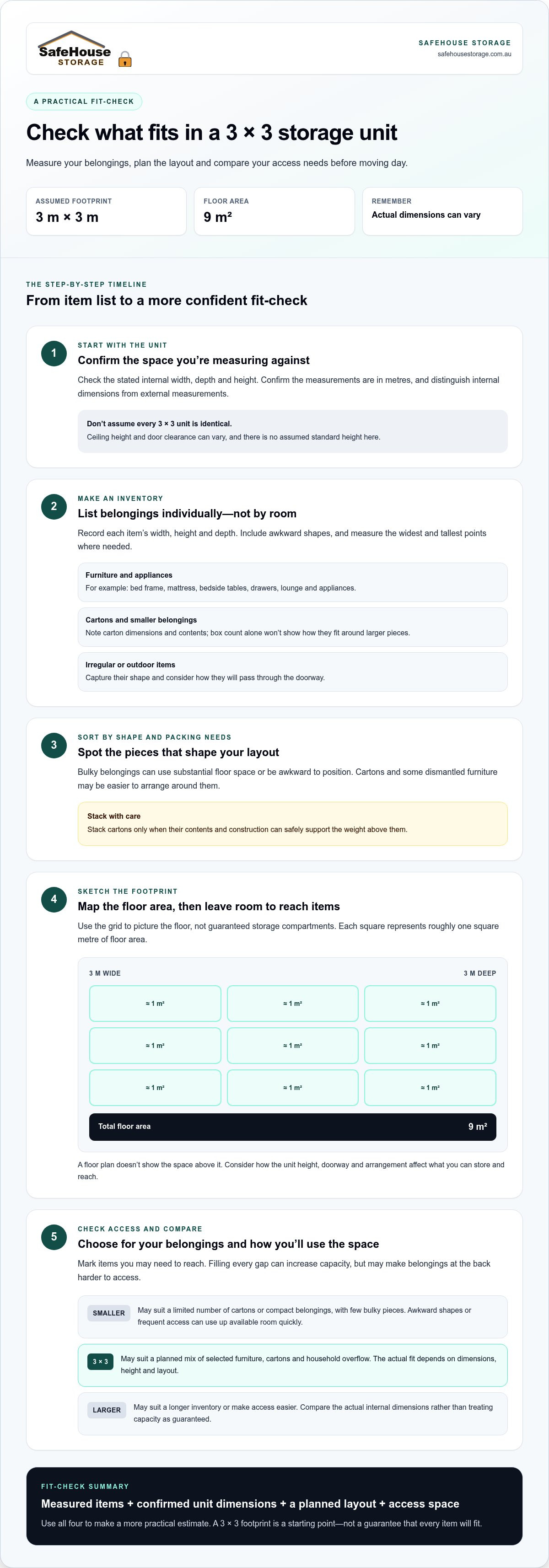
Use this simple floor-plan sketch to picture the footprint. Each square represents roughly one square metre of floor area, not a guaranteed storage compartment:
3 m wide
□ □ □
□ □ □
□ □ □
3 m deep. Total footprint: 9 m².
The sketch shows the floor, not the space above it. Before deciding what to store, compare the unit’s internal width, depth and height with your belongings. Allow room to manoeuvre larger items through the door, and decide whether you’ll need to reach anything once it’s packed away. Filling the whole footprint may increase capacity, but it can make access harder.
What furniture and household belongings can fit in a 3x3 storage unit?
A 3x3 unit may suit a planned mix of larger furniture and smaller household belongings, but there’s no universal inventory that fits every space. A mattress, lounge or appliance takes up room differently from cartons that can be stacked. The unit’s internal height, doorway and your packing method all affect the final layout.
An item list is more useful than a room label because it shows the actual size and shape of each belonging you need to store. The Self Storage Association of Australasia’s size guide offers broader context on common unit sizes, but measuring your own belongings is the best way to estimate your mix.
Could a bedroom’s furniture fit in a 3x3 unit?
Think of a bedroom as separate pieces, not one standard set. Measure the bed frame, mattress, bedside tables and drawers individually, including their width, depth and height. A dismantled frame may be easier to arrange alongside other belongings than an assembled one. Don’t assume every bedroom set will fit: furniture dimensions, unit height and the space needed to reach stored items all make a difference.
Make a quick inventory and group the contents by shape:
- Bulky pieces: Bed frames, mattresses, drawers, lounges and appliances. These can use substantial floor space or be awkward to position.
- Stackable belongings: Cartons, smaller household items and some dismantled furniture. Stack cartons only when their contents and construction can safely support the weight above them.
- Irregular items: Outdoor gear or oddly shaped belongings. Measure the widest and tallest points, and consider how they’ll pass through the doorway.
How many boxes and bulky household items might fit?
There’s no reliable box count without knowing the carton dimensions, contents and space left around larger pieces. Cartons can make use of gaps and vertical space, while a lounge or appliance may occupy a broad area that’s difficult to fill around. Keep access in mind as well. If you pack every gap, you may leave little room to reach belongings at the back.
For more context on choosing a smaller unit, read the small storage unit hire guide. Then compare your measured inventory with the unit’s internal dimensions and your access needs. You can also explore SafeHouse storage options to compare small, medium and large units for different storage needs.
What fits in a 3x3 unit compared with a smaller or larger option?
The right unit depends on your item mix, not just the number of belongings. A smaller space may suit compact items that stack neatly. A 3x3 footprint may give you more room for a combination of furniture and cartons, while a larger option can suit a longer inventory or make access easier. These are broad comparisons, not guaranteed capacity estimates. Actual internal dimensions and height vary.
| Option | May suit | Keep in mind |
|---|---|---|
| Smaller | A limited number of cartons or compact belongings, with few bulky pieces. | Awkward shapes and frequent access can quickly use up available room. |
| 3x3 footprint | A planned mix of selected furniture, cartons and household overflow. | Bulky items, unit height and the space needed to move around affect practical capacity. |
| Larger | A longer item list, several bulky pieces or belongings you need to reach regularly. | More floor area can help with layout, but compare the actual dimensions with your inventory. |
When might a smaller unit be enough?
A smaller option may work if you’re storing a few cartons, compact belongings or items that can be arranged closely together. Having few bulky pieces helps, as does having little need to access individual items once they’re stored. Make a list and note the largest pieces first. A single awkward item can use more practical space than several smaller, stackable belongings.
When is a larger storage unit worth considering?
Reassess the space if your list includes several large furniture pieces, irregularly shaped belongings or items you’ll need to retrieve often. Leaving a clear route to reach things takes room away from storage, and packing tightly around a lounge or appliance can make access difficult. If your layout only works by filling every gap, a larger option may be more practical.
To judge what fits in a 3x3 storage unit, compare your measured inventory with the unit’s internal dimensions, door access and usable height. Then decide whether you can group items efficiently while keeping the belongings you need reachable. SafeHouse Storage offers small, medium and large self-managed storage options. Compare the listed dimensions with your item list and access needs rather than assuming a size label guarantees a particular fit.
How can you check whether your belongings will fit before moving day?
A few measurements and a rough plan can replace a lot of guesswork. Work through five steps: measure each item, list its dimensions, group belongings by size and access needs, sketch a layout, then compare it with the unit’s stated internal dimensions.
Quotable tip: Measure every item, group it by size and access needs, then sketch the layout against the unit’s internal dimensions before moving day.
How should you measure furniture and boxes?
Record the width, height and depth of each item, measuring its longest points. Include handles, feet or other parts that stick out. For furniture you can safely dismantle, note both its assembled and dismantled measurements. Compare those dimensions with the unit’s internal measurements and doorway. Each item needs to fit through the entrance as well as inside.
Keep the inventory simple and useful. For each belonging, note:
- Item and quantity: For example, a chest of drawers or several cartons.
- Dimensions: Width, height and depth, including irregular shapes.
- Access: Whether you’ll need to retrieve it often or can place it towards the back.
- Handling: Whether it can be dismantled or safely stacked with other belongings.
Don’t rely on a single measurement for an awkward item. Measure its widest and tallest points, and consider the angle needed to manoeuvre it through the doorway.
How do you plan a useful layout inside the unit?
Draw the floor plan to scale using the unit’s internal length and width. Place the largest pieces first, then fit smaller belongings around them. Mark the doorway and leave room to move items in and out. A plan that uses every centimetre may look efficient, but it can make stored belongings difficult to reach.
Plan for access before you load. Put frequently needed items near the front where the layout allows, and position belongings you won’t need as often further back. If your plan only works by blocking everything behind the first layer, adjust it or reconsider the space you need.
Use this process to check what fits in a 3x3 storage unit against your actual belongings, not an estimate based on a room label. Once you’ve made your list and sketched a layout, explore SafeHouse storage options and compare the listed unit dimensions with your plan.
How can SafeHouse Storage help you choose a suitable unit size?
Choose a unit by matching your inventory and access plan to the dimensions shown for the storage space. A room label or rough guess can’t tell you whether a sofa will fit beside cartons or whether you’ll still be able to reach items at the back. Measure your belongings, note which ones you may need often, then compare your plan with the listed unit dimensions.
That’s the practical way to assess what fits in a 3x3 storage unit, or whether a different size is a better match. SafeHouse Storage offers small, medium and large self-managed storage options. Compare the dimensions for the option you’re considering with your full list, including bulky or awkward items and the space you want to leave for access.
What should you compare when selecting a SafeHouse unit?
Look beyond the total number of belongings. Compare each item’s measurements with the unit’s internal dimensions, and consider the doorway and how you plan to arrange everything. If you’ll need regular access, leave a route to reach stored items. If you’re storing furniture, decide where the larger pieces will go before adding smaller belongings around them.
SafeHouse Storage serves regional communities including Murray Bridge and Tenterfield, as well as Lithgow and Coonabarabran. Wherever you’re storing, work from your inventory and the unit dimensions rather than assuming a size name guarantees a particular fit. For furniture, see this guide to planning long-term furniture storage.
How can you arrange self-managed storage?
You can arrange storage through an online agreement or through a local real-estate partner. SafeHouse facilities are self-managed, gated and camera-monitored. Once you’ve compared your inventory and access needs with the unit dimensions, you’ll have a clearer basis for choosing a small, medium or large option.
Ready to take the next step? Explore SafeHouse storage options and compare the listed dimensions with your plan.
Choose a storage size with confidence
Choosing a unit is easier when you start with your belongings, not a size label. Measure bulky furniture and smaller items, compare them with the unit’s internal dimensions, and allow room to reach anything you may need. That’s the practical way to judge what fits in a 3x3 storage unit and whether a smaller or larger option better suits your plans.
SafeHouse Storage offers small, medium and large self-managed storage across regional South Australia and New South Wales. Its facilities are gated and camera-monitored, with options for storing belongings in Murray Bridge, Tenterfield, Lithgow and Coonabarabran.
Use your item list and access needs to compare the listed dimensions for each option. With a little measuring and planning, you can make a more considered storage choice and feel ready for moving day.
Frequently Asked Questions
What does a 3x3 storage unit mean in Australia?
In this guide, 3x3 means three metres by three metres, giving a floor area of nine square metres. Australian listings commonly use metric measurements, but the notation isn’t universal, so check the stated units and dimensions. Look for internal measurements, as external dimensions may include walls or other structure. The floor area also doesn’t tell you the unit’s height or how much space the doorway allows you to use.
How much furniture can fit in a 3x3 storage unit?
There’s no fixed furniture count because pieces vary in size and shape. A 3x3 unit may accommodate selected furniture alongside cartons, but a large lounge or several bulky items can use substantial floor space. Measure each piece separately, including its width, height and depth. Then consider whether it can be dismantled and how much room you want to leave to reach belongings once they’re stored.
Can a queen bed fit in a 3x3 storage unit?
A queen mattress may fit within a 3x3 footprint, but compare its measurements with the unit’s internal dimensions and doorway before moving day. The bed frame is a separate consideration, especially if it’s bulky or cannot be dismantled. Measure the mattress and frame individually, including protruding parts. Whether the complete bed fits alongside other belongings depends on the available height, the shape of each item and how you arrange the space.
How many boxes fit in a 3x3 storage unit?
There isn’t a reliable box count without knowing the carton sizes, what else you’re storing and the unit’s usable height. Make a list of carton dimensions, then plan around larger belongings such as furniture or appliances. Cartons can be stacked only when their contents and construction allow safe stacking. Leave room to reach items you may need rather than filling every gap and making the back difficult to access.
Can a car fit in a 3x3 storage unit?
A 3x3 unit is generally not a practical fit for a car. Its assumed three-metre-by-three-metre footprint is small for a vehicle, and the doorway and internal dimensions matter too. Don’t rely on the floor area alone. Compare the vehicle’s length, width and height with the unit’s internal measurements and entrance dimensions. If storing a vehicle is your goal, a larger space designed to accommodate its full size would be more suitable.
How do I know if I need a bigger storage unit?
Consider a larger unit if your item list includes several bulky pieces, irregularly shaped belongings or things you’ll need to access often. A layout that leaves no clear way to reach stored items may be too tight. Measure your belongings, sketch where the largest pieces will go, then compare the plan with the listed internal dimensions. SafeHouse Storage offers small, medium and large self-managed options in Murray Bridge, Tenterfield, Lithgow and Coonabarabran.
Does a 3x3 storage unit have enough height for stacking?
It depends on the unit’s internal height, which you can’t work out from its floor dimensions alone. Check the stated height and compare it with the items you plan to stack. Also consider doorway clearance and whether the cartons or belongings can be stacked safely. Leave access to items you may need, and don’t assume that using all the vertical space will make the unit easier to organise or retrieve belongings from.


