
For online sellers, ecommerce stock storage in Tenterfield means receiving stock, identifying it, organising it in a unit, then picking, checking and packing items as orders come in. For seasonal peaks, allow a 10-20% buffer above average stock levels so extra products don’t crowd your regular inventory.
Plan for the stock you’ll hold and how you’ll move through it, not just the floor space it needs. This guide explains how to estimate shed size, plan for seasonal and promotional stock, and consider security and incoming deliveries. You’ll also find practical ways to organise products and simplify order picking, whether you’re storing a small range or preparing for a busy selling period.
Key Takeaways
- Estimate stock volume, then allow an extra 30-50% for aisles and clearance when working out the space you need.
- Plan for peak periods with a 10-20% buffer above average stock levels, and keep seasonal items easy to reach.
- Make receiving smoother by checking incoming items against your records, then assigning each product a clear storage location.
- Use shelving, clear bins and location codes to make stock easier to find while keeping walkways clear.
- Review security, contents insurance and any restrictions on stored goods as part of your storage plan.
What Size Unit Does an Online Retailer Need?
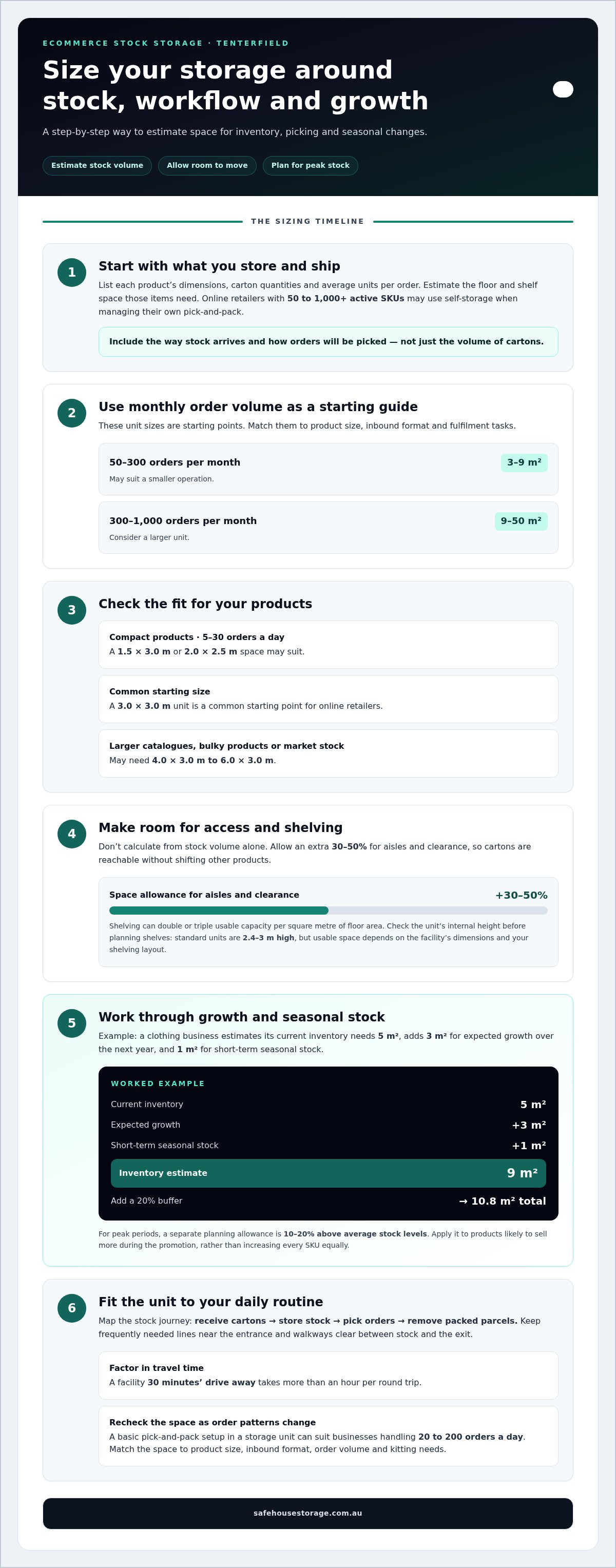
Choose a storage unit by the stock you hold, how it arrives and how you’ll pick orders. Online retailers with 50 to 1,000+ active SKUs may use self-storage when managing their own pick-and-pack. Start by listing each product’s dimensions, carton quantities and average units per order. Then estimate how much floor and shelf space those items need.
Order volume offers another starting point. A 3-9 m² unit may suit a business handling 50-300 orders per month. For 300-1,000 orders per month, consider a larger unit of 9-50 m². Compact-product sellers dispatching 5-30 orders a day may use a 1.5×3.0 m or 2.0×2.5 m space. A 3.0×3.0 m unit is a common starting size for online retailers. Larger catalogues, bulky products or market stock may need 4.0×3.0 m to 6.0×3.0 m.
Don’t calculate from stock volume alone. Add 30-50% to allow for aisles and clearance, so you can reach cartons without shifting other products. Shelving can double or triple usable capacity per square metre of floor area. Check the storage unit’s internal height before planning shelves. Standard units are 2.4-3 m high, but the usable space depends on that facility’s dimensions and your shelving layout.
For a worked example, a clothing business estimates its current inventory needs 5 m². It allows another 3 m² for expected growth over the next year and 1 m² for short-term seasonal stock. That brings the estimate to 9 m². Add a 20% buffer to the estimated inventory requirement, and the total becomes 10.8 m². This shows why growth and peak stock belong in the calculation, not just today’s inventory.
Location and access affect the daily workflow. A facility 30 minutes’ drive away takes more than an hour per round trip. If you collect stock or dispatch orders often, that travel time can disrupt picking and replenishment. Map your routine first: receiving cartons, storing them, picking orders and removing packed parcels. Keep frequently needed lines near the entrance, with clear walkways between stock and the exit.
Review the estimate as order patterns change. A basic pick-and-pack setup in a storage unit can suit businesses handling 20 to 200 orders a day. Match the space to product size, inbound format, monthly volume and any kitting needs. A spare room may work while stock is limited; a warehouse or storage units become more relevant as inventory and fulfilment tasks grow. Choose space that keeps stock organised without blocking access or leaving growth out of the plan.
Seasonal and promotional stock
Seasonal demand can leave a small online range short of space just as orders rise. Plan for stock before it arrives, rather than after cartons fill your picking area. In Australia, promotions such as Christmas sales or Black Friday can change which products need to be within easy reach. Start with last season’s sales, current stock and planned promotions. Use those records to estimate incoming inventory and how quickly it needs to move through fulfilment.
A practical starting point is to add a 10-20% buffer above average stock levels for peak periods. This gives you a planning allowance, not a forecast of sales. Apply it to the products likely to sell more during the promotion, rather than increasing every SKU equally. For example, if a clothing range has a seasonal colour or popular size, estimate its extra cartons separately. That makes the space estimate more useful and helps avoid crowding slower-moving lines.
Map the stock’s journey before arranging extra space. Note supplier delivery dates, where incoming cartons will go, and which products need to be picked first. Keep peak-season stock separate from everyday lines with clear labels or distinct shelf areas. If promotional products arrive early, place them where they won’t block access to regular orders. If they arrive close to the campaign, leave a clear receiving area for counting and sorting.
Build the storage period around the sales cycle. Some Australian online sellers may need extra space for 4-8 weeks before seasonal peaks. A clothing-business example allows an additional 1 m² for short-term seasonal stock. Use that as a prompt to calculate your own products’ carton sizes and handling space, rather than copying the example directly. Include room to open cartons, sort variants and reach stock without moving other products.
Scale storage with demand instead of keeping peak capacity all year. A seller might increase storage in October and reduce it in February, once seasonal stock has moved. Before changing the arrangement, check remaining quantities, supplier delivery dates and planned promotions. Keep records current so you don’t carry excess stock into the next cycle or reduce space while orders still need fulfilling.
After a promotion, count remaining stock and compare it with sales and returns. Record which products sold quickly, which remained and how much space they occupied. Use the results to adjust your next seasonal plan. A simple calendar can track order dates, inbound deliveries, promotion start dates and planned storage changes. This turns each busy period into useful information for the next one.
Security, contents insurance and prohibited goods
In Tenterfield, storage is offered in small, medium and large unit categories, while exact dimensions and access hours depend on the facility. Gated entry and camera monitoring are security features to look for; standard storage facility insurance may limit business inventory cover to A$1,500-A$2,500.
The value of stock held can exceed the cover available, especially during a seasonal peak. List your inventory, estimate its replacement value and compare that figure with your insurance cover. Read the policy wording for exclusions, excesses and conditions on goods kept in storage. Business contents cover may differ from cover for household belongings, so identify the stock as commercial inventory when arranging insurance.
Security relies on several layers. A gate controls entry, cameras monitor activity, and a suitable lock secures your individual shed. Keep a record of stock movements, delivery dates and returns. Use location codes so you can find items without searching through every carton. Limit access to people who handle orders, and remove it when their role ends. These steps support accountability, but don’t replace insurance or accurate stock records.
Weather, pests, theft and delivery delays can each disrupt orders. Moisture can damage cardboard packaging, while pests may affect goods stored in unsealed cartons. Where practical, keep stock off the floor, close cartons properly and inspect packaging when receiving deliveries. Camera monitoring can help deter unauthorised access, but it can’t prevent every loss. A late delivery can also leave popular products unavailable during a promotion, so track expected arrivals and align sales promises with stock on hand.
The storage agreement and facility rules specify prohibited goods. Read those terms before sending a supplier delivery or placing returns in storage. Separate damaged, returned and sale-ready products, then record each item’s condition. This reduces the risk of dispatching a returned product as new. Keep a current list of stored goods and don’t place anything in the shed that the agreement excludes.
Before moving stock, work through this short review:
- Match the unit size to the inventory volume and value you plan to store.
- Understand entry arrangements and how gates, cameras and unit locks are managed.
- Compare business contents cover with the replacement value of stock and packaging.
- Record incoming deliveries, returns and stock transfers to spot missing items.
- Keep walkways clear so stock can be reached and inspected without shifting cartons.
For ecommerce sellers, security and access affect daily fulfilment as much as protection from loss. A dedicated storage space can help separate orders, returns and packaging, but accurate stock records and suitable insurance remain important.
Ecommerce stock receiving and storage
Stock storage works best when every delivery follows the same path: receive it, identify it, assign a location, then record the quantity. That routine connects incoming goods with later picking, checking and packing. It also helps prevent new cartons from being mixed with older stock or customer returns.
At delivery, compare the items with the supplier’s paperwork and your purchase record. Check product codes, quantities and visible damage before putting stock away. If a carton contains several product variations, separate and label each group. Record discrepancies straight away, then keep affected goods apart until the stock record matches what you actually received.
Next, assign every product a location code. A code such as “Shelf B, Bin 2” makes the storage map easier to use than a note saying “near the back”. Add that code to your inventory system and product label. Clear boxes or bins make items easier to identify, while shelving uses vertical space. Keep walkways clear and place frequently picked products near the entrance.
For a small operation, a garage or spare room may hold stock while monthly orders remain low. As inventory grows, self storage can separate business stock from household items and create a dedicated picking area. The location still needs a practical workflow: leave space to receive cartons, sort products and pack outgoing orders without blocking stored goods.
Keep records current as stock moves. Each time you receive, pick, return or relocate a product, update its quantity and location. Count a subset of SKUs on every visit, then rotate through the full range over 4-6 weeks during active operations. Complete a full physical stock count at least once a quarter. These checks help reveal missing items, incorrect quantities and products recorded in the wrong place.
Returns need their own clear process. Separate them from sale-ready items, inspect their condition and update their status before returning them to available stock. Otherwise, an item awaiting inspection could be picked for an order by mistake. Keep damaged or incomplete goods in a clearly marked area, and record why they’re being held.
Match the setup to the workload. Businesses with 0-50 orders per month are typically at a starting-out stage, often using a home or spare room. At 1,000 or more orders per month, a commercial warehouse lease or fulfilment provider may become appropriate. In between, review SKU count, carton format, average units per order and packing needs. A flexible layout lets you add shelving or move fast-selling lines without rebuilding the whole system.
What ecommerce warehousing and storage services are available in Tenterfield, NSW?
For an online seller in Tenterfield, the main choices are home storage, a self-managed shed, shared warehouse space, a commercial warehouse or outsourced fulfilment. Each supports a different part of the stock journey. A spare room may suit a small range, while a separate shed can give growing inventory its own organised space. A warehouse or fulfilment provider may suit businesses with larger volumes or more complex dispatch needs.
A self-managed shed gives you space to hold stock and manage picking and packing yourself. You control inventory records, product locations and the order workflow. This suits businesses that want to keep fulfilment in-house and can make regular trips to their stock. Choose a shed size that suits your product mix, incoming cartons and the room needed to reach stock. Seasonal demand can also affect how much space is useful during busier periods.
Shared warehouse space is another model: stock is kept in a shared facility rather than dedicated business premises. Before choosing this format, map the work you’ll still handle yourself, including receiving deliveries, counting products and dispatching orders. If a facility provides fulfilment, clarify which steps it carries out and which remain yours. The key distinction is whether you need space alone or help handling stock.
A commercial warehouse gives a business a larger premises to operate from. Commercial warehouse leases typically involve a 2-5 year commitment, so consider how stable your sales and stock requirements are before taking that path. Commercial warehouses are listed as offering 24/7 access, which can help businesses needing access outside standard working hours. Access hours still matter less if your main need is occasional stock collection.
Order volume can help identify when a different setup may be worth considering. A 3PL or fulfilment provider is usually suitable once an Australian ecommerce business reaches 30-100+ orders a day. At 1,000 or more orders per month, a commercial warehouse lease or 3PL may be appropriate. These are planning points, not automatic cut-offs. Product size, inbound format, average units per order and packing needs all affect the workload.
Compare the options against your actual tasks:
- Home storage: useful when stock fits safely into a spare room and order handling stays manageable.
- Self-storage: suited to holding stock while you manage inventory and fulfilment yourself.
- Shared space: consider how access, receiving and handling responsibilities fit your workflow.
- Warehouse or 3PL: weigh the space or fulfilment support against your order volume and business plans.
List your monthly orders, stock volume and receiving needs before deciding. To explore storage options for holding ecommerce stock, view storage options.
SafeHouse Storage: Small Storage Units
SafeHouse Storage offers small, medium and large storage units for online sellers who need space for stock beyond a home office, garage or spare room. Choose a unit size around your product volume, seasonal stock and picking workflow. The space is self-managed, so you organise stock, track inventory and prepare orders yourself.
SafeHouse Storage facilities are gated and camera-monitored. If your ecommerce stock in Tenterfield needs a separate place between supplier delivery and dispatch, a storage unit can help keep business inventory apart from household belongings. It’s a practical fit when you want storage space, rather than outsourced picking and packing.
For a straightforward next step, contact SafeHouse Storage to discuss your storage needs.
Set up your next stock move
Turn your storage plan into a simple working routine. Before stock arrives, decide where deliveries will be checked, how products will be labelled and which items need to stay close to your packing area. Clear responsibilities and accurate records help keep orders moving as your range changes.
For ecommerce stock storage in Tenterfield, choose an arrangement that fits how you receive and dispatch goods now, while leaving room to adjust as demand shifts. Review it after each busy period. Use what sold, what remained and what caused delays to guide your next decision. Small changes to your stock layout can make the next seasonal rush easier to manage.
SafeHouse Storage offers Small, Medium and Large Storage Units for businesses needing space to hold stock. Contact SafeHouse Storage today to discuss your storage needs and take the next step with confidence.
Frequently Asked Questions
WHAT CAN YOU STORE IN AN E-COMMERCE STORAGE UNIT?
A storage shed can hold inventory and related business stock, subject to the storage agreement. Keep products sorted by SKU, with returns or damaged items separate from sale-ready goods. For example, record a carton’s product code and storage location before picking orders. Check the agreement’s rules for stored goods before moving items in. With SafeHouse Storage’s self-managed sheds, you organise and track your own stock.
Can I use a storage unit as a pick-and-pack centre?
You can use stored stock as the base for your own picking and packing routine, subject to the storage agreement. Set aside a clear area for checking orders and preparing parcels without blocking access to stock. SafeHouse Storage provides self-managed sheds, not order fulfilment. You handle inventory, pick each item, pack it and arrange dispatch yourself.
Can delivery drivers or couriers drop stock to my unit?
SafeHouse Storage’s unmanned sheds don’t provide a staffed receiving service or accept deliveries on your behalf. Arrange how deliveries will reach your shed, and plan to receive, count and put away stock yourself. Give suppliers clear delivery instructions and keep a record of expected arrivals. This helps you coordinate incoming cartons with sales and avoid confusion about which goods are ready to fulfil orders.
Can delivery vehicles access the loading areas?
SafeHouse Storage’s Tenterfield site has drive-up access to all sheds, so vehicles can reach the shed doors. This makes it easier to move cartons between a vehicle and your storage space. Drive-up access doesn’t mean a courier can leave stock unattended or that the site handles deliveries for you. Plan to receive the goods yourself and keep the route to your shed clear.
Is my stock covered by insurance in storage?
Don’t assume your business inventory is automatically covered by the storage arrangement. Review your business contents policy and identify stock held away from your usual premises. Check how it treats theft, accidental damage, stock in transit and goods awaiting inspection. Keep purchase records and an inventory list to document what you store. SafeHouse Storage provides space; you’re responsible for arranging suitable cover for your stock.
Are there self-storage facilities in Tenterfield suitable for ecommerce inventory?
SafeHouse Storage has a Tenterfield site at 36 Riley Street, with gated, camera-monitored sheds and drive-up access. Its current listing shows the site as full, with a waiting list, so it isn’t presently open for leasing. For ecommerce stock storage in Tenterfield, this means planning around the listed waiting status. SafeHouse Storage also operates in Murray Bridge, Lithgow and Coonabarabran.
Can Tenterfield storage providers handle receiving, packing, and shipping online orders?
SafeHouse Storage rents self-managed sheds; it doesn’t receive, pack or ship online orders for you. You manage supplier deliveries, stock records, order picking, parcel packing and courier arrangements. If you store inventory at the Tenterfield site, set up your own workflow for each task. This option suits sellers who want storage space and intend to manage fulfilment themselves.
What should ecommerce sellers compare when choosing stock storage in Tenterfield?
For ecommerce stock storage in Tenterfield, compare shed size, vehicle access, security features, receiving arrangements and the agreement’s rules for stored goods. Consider whether you’ll manage stock and dispatch yourself or need outsourced fulfilment, which is a different service. SafeHouse Storage’s Tenterfield sheds are gated, camera-monitored and drive-up accessible. These features don’t include receiving or packing support, which you manage separately.


