
The closest storage site isn’t always the best fit. For small business storage in Tenterfield, start by listing what you need to store, then compare shed size, security, location and payment arrangements. A space estimate is only a guide: the right fit also depends on what you’re storing and how often you need to access it.
A straightforward storage option can help keep business goods organised without adding hassle to your working week. This guide explains how to estimate the space you need, book a shed online and choose a payment frequency. You’ll also learn what to consider when reviewing site security and access, so you can match the arrangement to your business needs.
Key Takeaways
- List the items you plan to store and how often you’ll need them. Use a space estimator as a starting guide, then allow room for practical access.
- Compare security features such as gates, camera monitoring and unit alarms, and consider how you’ll secure your own unit.
- Check facility access hours against your work routine so you can reach stored stock or equipment when you need it.
- Match the unit size to your business items, then review the online agreement and monthly payment arrangements before booking.
Estimating storage space
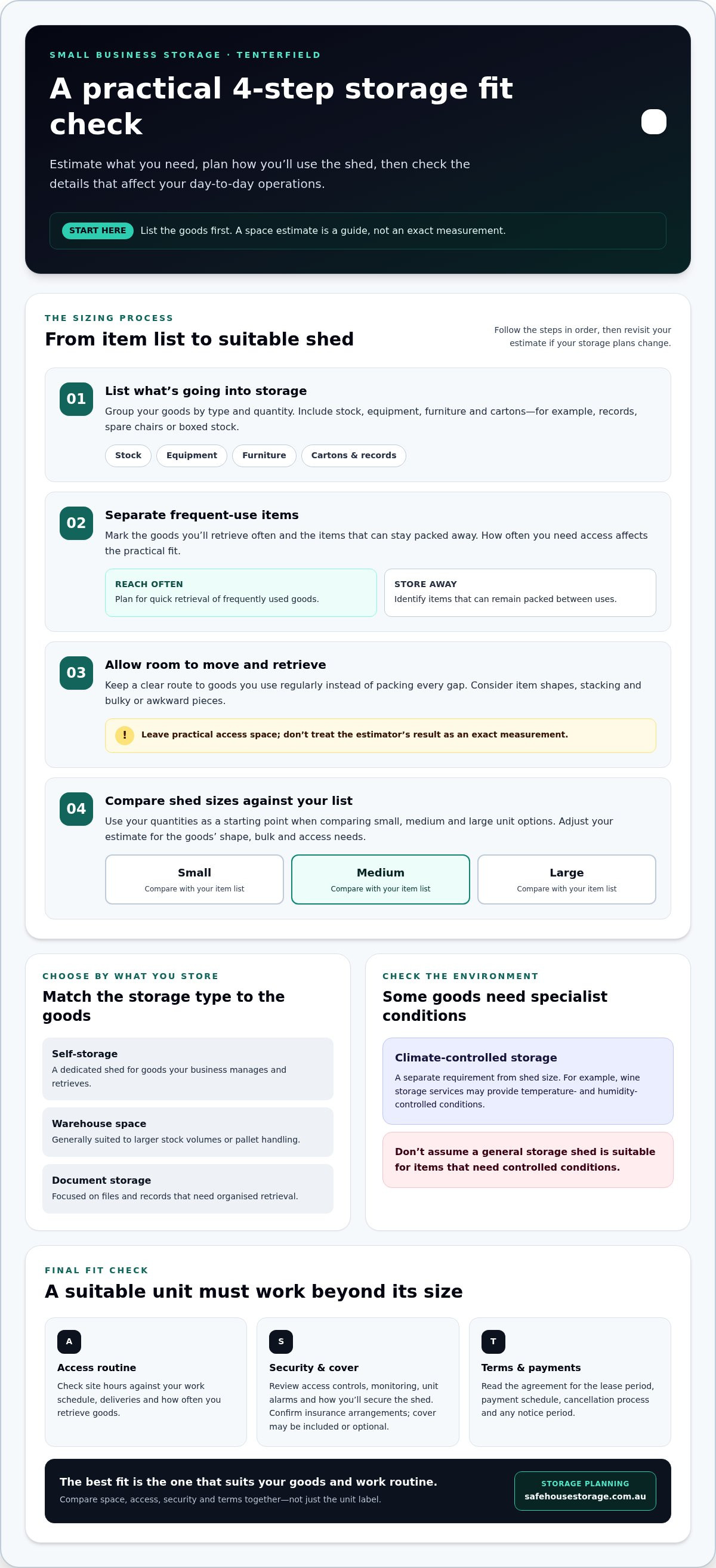
Start with an item list, not a guess about floor area. Group stock, equipment, furniture and cartons, then note how much of each you plan to store. Use these quantities to estimate the space required, but treat the result as a guide. The fit also depends on item shapes, stacking and how often you need access.
Use this simple process for small business storage in Tenterfield:
- List each item type and quantity, such as cartons of records, spare chairs or boxed stock.
- Separate items you’ll retrieve often from those staying in storage.
- Allow a clear route to frequently used goods, rather than packing every gap.
- Compare your list with small, medium and large unit options, then adjust for bulky or awkward items.
Self-storage gives a business a dedicated shed for goods it manages and retrieves. Warehouse space is generally suited to larger stock volumes or pallet handling, while document storage focuses on files and records that need organised retrieval. In Tenterfield, choose according to the goods and access routine, not just the label.
For NSW business storage, the agreement sets out the lease period, payment schedule, insurance arrangements and how cancellation works. Read those terms before signing, including any notice period and responsibility for cover. Insurance may be included in the storage price or offered as an optional extra, so don’t assume stored goods are automatically insured.
Small, medium and large sheds give small businesses a starting point for comparing space. Choose according to the amount you’ll store and how often you need access, rather than assuming one size suits every business.
Climate-controlled or specialist storage is a separate requirement from shed size. For example, wine storage services may provide temperature- and humidity-controlled conditions. Don’t treat a general storage shed as suitable for goods that need controlled conditions; match the storage environment to the items.
Before settling on a unit, use the estimate as a starting point, not an exact measurement. Storage space estimators commonly estimate space by asking customers to select the quantity of each item they plan to store; check that the selections reflect what will actually go into the unit.
The space you need also depends on access requirements, the types of items stored and how you use the shed. Review your estimate if your storage plans change.
Secure storage facilities
Security involves more than a locked door. Consider the site’s access controls and monitoring, as well as how you’ll secure your own stock or records.
Business risks include theft, damage, unauthorised access and being unable to reach essential equipment when needed. Insurance may be included in the storage price or offered as an optional extra, so understand the cover arrangements before storing valuable goods.
Available Facility Options
Tenterfield businesses can compare self-managed storage units with warehouse space or document storage, depending on what needs protection. For cartons of stock or tools, consider how the unit is secured and whether you can keep access to the goods you use regularly.
Look for security fencing, monitored cameras, alarms on individual units and clear access controls. A facility may have a 24-hour closed-circuit security video system; confirm how its security features work in practice. Also consider the risks posed by poor packing, damp conditions or stacking heavy items unsafely.
Before storing goods, make an inventory and note their condition. Keep essential business records backed up separately, and avoid storing items you may need urgently if you can’t access the site. Plan how you’ll secure the shed and control its keys.
Facility Locations and Contacts
Business storage facilities serving Tenterfield may be located in town or in the surrounding area. Compare the site address with your usual work route, delivery needs and the time required to collect stock or equipment.
Use the facility’s published address and contact details to ask about site access, security arrangements and insurance options. An online agreement can provide a direct booking route, while local real-estate partners may assist with storage arrangements. Keep the agreement and contact details with your business records.
For a practical comparison, review storage unit options alongside your security and access needs. Choose a facility that suits the items stored and the way your business operates, rather than relying on a single security feature.
Storage access and opening hours
For a Tenterfield business, access hours affect when you can collect stock, tools or records. Access varies by facility: some allow entry at any time, while others limit visits to opening hours. Plan around the hours that suit your working routine.
Tenterfield storage facilities may offer business features such as access at any time, drive-up access or loading areas, but these vary by site. Multi-storey facilities may provide moving trolleys and goods lifts. Vehicle storage is a separate requirement, so don’t assume a standard storage unit includes it.
Match the access arrangement to what you store. If you collect stock before opening, check whether the site’s access arrangements work with your schedule. If equipment stays packed away between projects, less frequent visits may suit. A business retrieving records occasionally has different needs from one replenishing stock throughout the week.
- Note when you expect to visit, such as before work, during business hours or after a delivery.
- Consider how you’ll move items from your vehicle to the unit, including bulky cartons or equipment.
- Plan which goods need to sit near the entrance for quick retrieval.
Drive-up access can make loading and unloading easier, while trolleys and goods lifts can help move items through a multi-storey site. Think through a real trip: carrying several cartons from a vehicle takes more time if the unit is far from the loading point. Keep frequently used goods easy to reach.
Record the facility’s opening hours and entry process with your storage agreement. Share those details with any staff who need access, and agree on who holds the unit key. If deliveries are part of your routine, align arrival times with the facility’s access arrangements. That helps avoid a wasted trip or delayed stock collection.
For a business choosing storage in Tenterfield, access is a practical part of the space decision. Consider your visit schedule, vehicle access and how you’ll handle stored items, then choose an arrangement that supports the way your business operates.
What small business storage facilities are available in Tenterfield NSW?
For a Tenterfield business, the main storage formats to compare are self-storage units, warehouse space and document storage. Each suits different goods and access needs, so match the facility type to your stock, equipment or records before comparing terms.
A storage shed suits boxed stock, tools, spare furniture or seasonal display materials that your team may need to retrieve. Warehouse space can suit larger stock volumes or pallet handling. Document storage focuses on business files and records, where organisation and retrieval matter more than loading space.
- Self-storage: consider unit size, entry arrangements and how goods are stacked.
- Warehouse space: assess the volume of goods and whether pallet handling matters.
- Document storage: plan how files will be labelled, protected and retrieved.
For example, a local retailer holding spare shelving and boxed stock may prefer a shed with room to reach frequently used items. A tradesperson storing bulky tools should consider loading access as well as floor space. An office keeping archived records needs an orderly system, not simply an empty corner.
In Tenterfield, compare the facility’s location with your regular work route and delivery patterns. Then weigh the space size, storage duration and types of items stored, as these factors can affect the overall price. Read the agreement for payment timing, insurance arrangements and cancellation terms before committing.
Some storage needs call for specialist conditions. Wine storage services, for instance, may provide temperature- and humidity-controlled conditions. General storage should not be treated as equivalent when goods need a particular environment. For everyday business stock, equipment or cartons, focus on suitable space, practical access and the site’s security features.
Make a short comparison before booking: note the goods, expected visits, loading needs and agreement terms for each option. This turns a broad search into a clear choice for your business. View storage options as you compare the space your business needs.
SafeHouse Storage: Small Storage Units
SafeHouse Storage offers small, medium and large storage units for businesses that need room for stock, equipment or other goods. Choose a size by considering what you’ll store and how you’ll arrange it for access. A smaller unit can suit a compact load, while a larger one may fit bulkier items or more stock.
SafeHouse Storage’s self-managed sites are gated and camera-monitored, and you can book a shed online. This is a practical next step once you’ve estimated your storage needs and considered access and security.
To explore the available unit sizes and take the next step, visit SafeHouse Storage online.
Make your next storage decision with confidence
Before arranging small business storage in Tenterfield, turn your estimate into a simple working plan. Note what you’ll store, which items need regular access and how your needs may change as stock moves through the business. This gives you a useful basis for choosing shed space and a payment frequency, rather than relying on a one-off guess.
SafeHouse Storage offers Small Storage Units, Medium Storage Units and Large Storage Units. Choose the size that best matches your business items and storage plan, then take the next step when you’re ready.
Contact SafeHouse Storage today to discuss your storage needs. A clear plan can help you make room for the work ahead.
Frequently Asked Questions
How do I hire the best local storage business near me?
Choose a storage business by matching its location, agreement and access arrangements to your work routine. For small business storage in Tenterfield, the local site is at 36 Riley St, with Alford & Duff First National as its management partner. SafeHouse Storage also has sites in Murray Bridge, Lithgow and Coonabarabran, so choose the location that suits your business needs and travel route.
What are the access hours and security measures at Tenterfield storage facilities?
Access hours vary between facilities, so your working schedule matters. SafeHouse Storage’s Tenterfield site at 36 Riley St has drive-up access, which can make loading goods into a shed more direct. Its facilities are gated and camera-monitored. The Tenterfield site is listed as full with a waiting list, and Alford & Duff First National is the local management partner.
How can a small business choose and book a storage unit in Tenterfield?
Choose a shed size based on what you’ll store, or start with a rough description of your goods. To book online, provide your contact details, a photo of your driver’s licence, preferred start date and payment frequency. You can select weekly or monthly payments. An alternate contact is optional. The storage agreement goes to the local agent for countersignature, so allow time for that step.


