
The lowest advertised rate isn’t always the best-value storage option. The storage unit price per month NSW renters pay can vary with unit size, location and rental terms, so a headline figure rarely tells the whole story.
Comparing prices is easier when you match the details. A unit in a regional town may differ from one in a metropolitan area, and the billing period or rental conditions can affect your budget. Start with how much space you need, how often you’ll visit and which location suits you, then compare the rental terms.
This guide explains the main factors behind monthly storage prices and gives you a consistent way to weigh options in NSW. It covers small, medium and large self-managed units, with local comparisons for Lithgow, Tenterfield and Coonabarabran. SafeHouse Storage also operates in Murray Bridge, South Australia. Focus on a practical fit for your belongings and routine, not just the first figure you see.
Key Takeaways
- Understand why the storage unit price per month NSW can vary with space, location, access and rental terms.
- Compare like with like by matching unit sizes and billing periods before weighing advertised rates.
- Compare storage options in Lithgow, Tenterfield and Coonabarabran using the same criteria for each town.
- Estimate your budget by separating ongoing rent from separately stated charges and one-off transport costs.
- Explore SafeHouse Storage’s small, medium and large self-managed units in regional NSW, as well as its Murray Bridge facility in South Australia.
What shapes a storage unit price per month in NSW?
A monthly storage price is the rental charge for a chosen space over the billing period set out in the rental agreement. If one rate is shown weekly and another monthly, compare them only after you understand how each is billed. Keep other costs, such as transport or packing, separate from rent so they don’t distort the comparison.
A storage unit price per month in NSW depends chiefly on location, unit size, rental terms and the access arrangements included. These factors work together. A larger space may cost more than a small one, while units of similar size can still differ in price or suitability if their locations and rental terms aren’t comparable.
The Self-storage industry overview offers general background on how self-storage works. For a useful price comparison, focus on the details that affect your own use: the space you need, where the facility is, how you’ll access your belongings and what the rental agreement says about billing.
Why location can affect a NSW storage comparison
Don’t assume metro and regional locations have the same pricing. Local conditions and facilities differ, so a rate from a major city isn’t a reliable stand-in for a regional town. Compare options in places that are practical for you, including Lithgow, Tenterfield and Coonabarabran. To judge prices between towns, use current figures for units of similar size and terms rather than assuming one town costs less than another.
Distance matters to your decision, too. A unit near home or work can make frequent visits easier, while a location farther away may suit belongings you rarely need. Consider the time and travel involved alongside the rental charge, particularly if you expect to collect items regularly.
How unit size and rental terms change the comparison
Small, medium and large units suit different storage needs, so comparing different sizes can give a misleading picture. First decide what you plan to store and how you need to reach it. Then compare units in the same size category. For help thinking through a smaller space, the Small Storage Unit Hire: Guide for Regional NSW & SA covers small-unit storage in more detail.
The agreement sets out the billing period and applicable rental terms. Read those details before treating an advertised figure as your monthly commitment. Also consider the access arrangements described for each facility. They can make a difference if you expect to visit often or need to retrieve stored items as part of your work.
Keep rent separate from the costs of getting your belongings to storage. Moving, transport and packing expenses aren’t storage rent, even if they affect your overall budget. A clear comparison can group costs like this:
- Storage rent: the charge for the chosen unit over the agreement’s stated billing period.
- Other expenses: moving, transport or packing costs, listed separately from rent.
This distinction makes it easier to compare storage options fairly and plan for the full cost of your move without confusing one-off expenses with ongoing rent.
How to compare monthly storage prices without missing the details
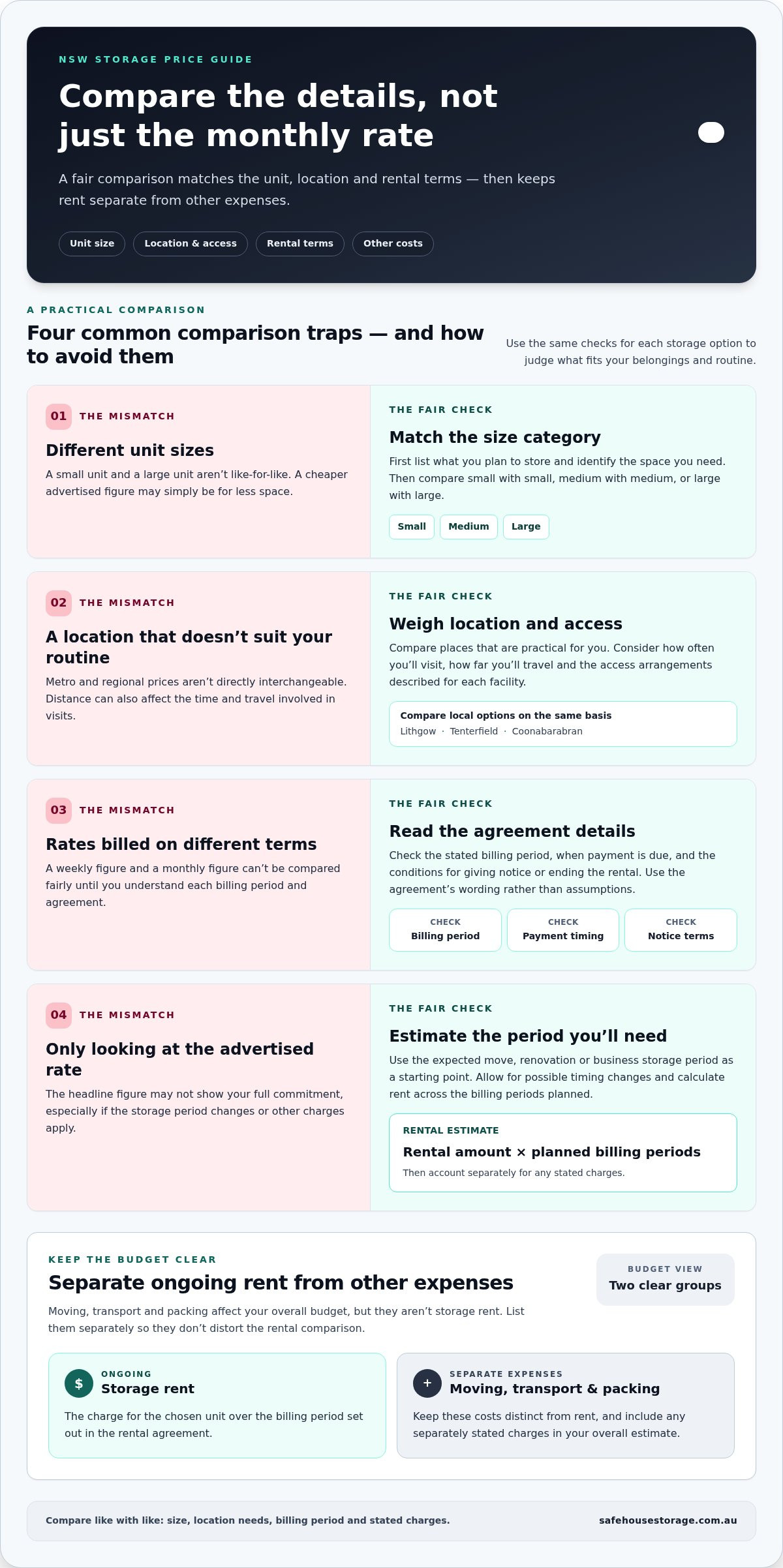
A fair comparison takes more than putting two advertised rates side by side. A lower figure may relate to a different unit size or billing period, while the agreement may include terms that affect your overall commitment. Use the same steps each time to compare practical options on equal terms.
- Match unit size. Compare spaces in the same size category, rather than weighing a small unit against a large one. Make a short inventory of the items you plan to store to help identify the space you need.
- Compare location. Consider how far you’ll travel to the facility and whether it suits how often you’ll need access.
- Read the rental terms. Check the billing period, payment timing and notice conditions in writing.
- Review the total commitment. Estimate the rental cost for the period you expect to need storage, then add any separately stated charges.
Compare the same unit size, location needs, billing period and stated charges before deciding which rate offers better value. This checklist makes a storage unit price per month NSW comparison more useful, even when the advertised rates look similar.
What to check in a monthly rental agreement
Read the agreement before relying on a monthly figure. Look for the stated billing period, when payment is due and the conditions for giving notice or ending the rental. These details can vary, so use the agreement’s wording instead of assuming every facility handles them in the same way.
Note any charges shown separately from rent and include them in your comparison. Keep recurring rental charges distinct from one-off costs. That gives you a clearer view of what you’re committing to pay for the unit and what relates to other parts of your move.
How to estimate the rental period you need
Start with the reason you need storage. For a move, estimate the gap between leaving one home and being able to move into the next. For a renovation, use the expected work period as a starting point. A business storing stock or equipment can consider how long the extra space is likely to be useful.
Make a realistic estimate and allow for possible timing changes. If the rental period grows, your total commitment grows too, even if the monthly rate stays the same. Multiply the rental amount by the number of billing periods you plan to use, and account separately for any stated charges. The guide Moving Storage Solutions NSW: The Ultimate Regional Guide (2026) also explores storage planning around a move.
Once you’ve worked through these steps, you can compare options with a clearer picture of the space, terms and likely rental period. If regional self-managed storage suits your plans, explore SafeHouse Storage options in NSW.
Comparing storage options in Lithgow, Tenterfield, and Coonabarabran
Regional storage comparisons work best when they reflect how you’ll use the unit, not just which rate looks lowest. SafeHouse Storage offers small, medium and large self-managed units in Lithgow, Tenterfield and Coonabarabran. Compare the same size category and billing period in each town, then weigh the rental terms and practical travel involved. For customers considering storage outside NSW, SafeHouse also has a facility in Murray Bridge, South Australia.
Use the table as a checklist for comparing the rental amount and terms for the unit you need in each town. Matching the size and billing period makes the comparison more useful than relying on a headline figure.
| Town | Unit size categories | Price details to compare |
|---|---|---|
| Lithgow | Small, medium and large | Rental amount, billing period and agreement terms for the unit you need. |
| Tenterfield | Small, medium and large | Compare the same size and billing period, then note any separately stated charges. |
| Coonabarabran | Small, medium and large | Compare the rental amount and terms for a unit in the same size category. |
What regional renters should compare by town
Start with your regular travel route. If you’re likely to visit the unit often, consider which town makes those trips practical. If you’re storing items you rarely need, convenience may matter less than choosing suitable space and understanding the rental commitment.
For a fair price comparison, match the unit size and billing period, then read the agreement terms. A small unit in one town isn’t a like-for-like comparison with a large unit elsewhere. The storage unit price per month NSW renters see is only one part of the decision; travel and intended use matter too.
When a small, medium, or large unit makes sense
A small unit may suit a modest amount of household belongings or business items. A medium unit can provide more room for a broader storage need, while a large unit may suit a greater volume of household or business goods. Make an inventory and consider which items you may need to access. This can help you choose a suitable size without paying for space you don’t expect to use.
SafeHouse’s NSW & SA Regional Storage: Secure Self-Storage Guide provides more context on regional storage. Before choosing a town, compare the full rental terms and consider how the location fits your routine. A practical option balances the space you need with a location you can use comfortably.
Build a storage budget that reflects your actual monthly commitment
A storage budget should show what you’ll pay for the rental period you expect, not just the rate for one month. Start with the unit’s monthly rental amount and a realistic estimate of how long you’ll need it. Then include any separate charges stated in the rental terms.
Budget formula: monthly rental amount × planned months + separately stated rental charges. Keep one-off moving or transport expenses in a different part of your budget. This makes it easier to see the storage commitment on its own and understand how it fits alongside the rest of your plans.
How to plan for short and longer storage periods
Think through the event that creates the need for storage. If you’re moving, estimate the time between leaving one property and settling into the next. During a renovation, consider how long belongings may need to stay out of the way. A business storing stock can estimate how long it expects to need the extra space.
For example, if a renovation takes longer than planned, the rental period may extend. The monthly rate might remain unchanged, but the total commitment increases with each additional month. Use the agreement to understand the billing period and notice conditions, then make your estimate against those terms instead of assuming how charges are timed.
Which expenses belong in a storage budget?
Separate costs by what they cover. Storage rent is the recurring charge for the unit. Transport, moving labour and other expenses arranged separately belong in their own budget lines. Include additional rental charges only when they’re stated in the relevant agreement or terms. Don’t treat a one-off moving expense as part of the ongoing storage rate.
A short review before committing can help keep your estimate realistic:
- Estimate how long you’re likely to need the unit, and allow for possible timing changes.
- Check the agreement’s billing period, payment timing and notice conditions.
- List separately stated rental charges alongside the rent.
- Keep transport, moving labour and other external costs separate from storage rent.
- Revisit the estimate if your move, renovation or business need changes.
This approach gives you a clearer view of the storage unit price per month NSW customers are comparing and the total rental commitment over time. It also helps keep your choice grounded in both the space you need and the period you expect to use it.
Once you have a budget in mind, explore SafeHouse Storage locations and unit options in regional NSW.
Rent a SafeHouse storage unit in regional NSW
Once you’ve compared space, location and rental terms, choose the option that fits your plans. SafeHouse Storage offers small, medium and large self-managed storage units in Lithgow, Tenterfield and Coonabarabran. Choose the town that works for your household or business, then consider which unit size suits what you need to store. SafeHouse also operates in Murray Bridge, South Australia.
There’s no need to base your decision on a headline figure alone. The storage unit price per month NSW renters consider is only one part of the picture. Your chosen space, the rental agreement and how practical the location is for you all matter. SafeHouse facilities are unmanned, gated and camera-monitored.
What renting self-managed storage with SafeHouse involves
Self-managed storage means you rent a unit for your belongings and manage your stored items yourself. SafeHouse customers can arrange a rental agreement online or get assistance through local real-estate partners. The facilities are unmanned, so staff aren’t present on site.
SafeHouse facilities have gated access and camera monitoring. These are features of the site, not a promise of a particular outcome. Read the agreement so you understand its stated billing period and applicable terms before arranging a rental.
How to take the next step in NSW
Start by choosing the SafeHouse town that best fits your needs: Lithgow, Tenterfield or Coonabarabran. If you’re considering options across the border, SafeHouse also operates in Murray Bridge. Think about how often you may need to reach your belongings, then compare small, medium and large units against the space you expect to use. A suitable fit helps keep your choice practical, whether you’re storing household belongings or business items.
Next, review the rental details for the option you’re considering. Include the agreement’s billing period and terms in your budget, rather than assuming every rental works the same way. You can arrange an agreement online or get assistance through local real-estate partners.
As you weigh up your options, use the comparison points in this guide: town, unit size, rental terms and how the location fits your routine. Then choose the space that makes sense for your needs and planned rental period. SafeHouse’s regional NSW locations offer local renters small, medium and large self-managed options to consider.
Ready to explore the local choices and arrange a suitable rental? Find SafeHouse Storage options in regional NSW.
Make your next storage decision with confidence
Before arranging storage, decide what needs to be close at hand and what can stay packed away. This can help you choose a unit size and think through how often you’ll visit. Keep your rental agreement details and budget together so you can refer to them if your plans change.
Choosing a storage unit price per month NSW option is easier when you know what matters most: a practical location, enough room for your belongings and rental terms that fit your plans. Start by comparing the town and unit size that seem most suitable, then read the rental information before making your decision.
SafeHouse Storage offers self-managed storage in Lithgow, Tenterfield and Coonabarabran, with small, medium and large units. You can arrange a rental agreement online or get assistance through local real-estate partners. Find a SafeHouse Storage unit in regional NSW and take the next step towards making room for what’s ahead.
Frequently Asked Questions
How much does a storage unit cost per month in NSW?
There isn’t one set storage unit price per month across NSW. The amount depends on factors such as unit size, town and rental terms. For a useful comparison, look at the rental amount for the specific space and billing period you need. SafeHouse Storage rents small, medium and large units in Lithgow, Tenterfield and Coonabarabran, and also operates in Murray Bridge, South Australia. Include the rental terms in your budget.
Is storage charged by the calendar month?
Not necessarily. The rental agreement sets out the billing period, so a monthly rate doesn’t automatically mean billing runs from the first to the last day of each calendar month. If you begin storing belongings part-way through a month, check how the agreement describes the first payment and later billing dates. Use the stated payment timing to plan your cash flow instead of assuming every facility bills in the same way.
Does a monthly storage price include access and security?
Read the rental agreement and facility information to understand the access arrangements tied to your rental. SafeHouse facilities are unmanned, with gated access and camera monitoring. These features describe the site, but don’t guarantee a particular outcome. If you’re storing business stock or household items you may need regularly, consider how the access arrangements fit your routine.
Can I rent a storage unit for a short period in NSW?
Short-term storage can suit a gap between moving dates, a home renovation or a temporary need for extra business space. SafeHouse Storage rents units for short-term and long-term use. The agreement sets out the applicable rental period and conditions, so read it before planning when you’ll move items in or out. If your plans could shift, include that possibility in your budget and keep track of the agreement’s notice requirements.
Do businesses pay a different monthly storage price?
Business use doesn’t automatically mean a different rate; the price depends on the unit and rental terms. A sole trader holding surplus stock may need a different amount of space from a business storing equipment, so compare options based on the goods and volume involved. Consider how often you’ll need to retrieve items, too. That can help you select a practical unit size and location for day-to-day operations.
What should I check before agreeing to a monthly storage rental?
Read the agreement for the billing period, payment timing, notice conditions and any separately stated charges. Make sure the unit size and town match what you intend to rent, and understand the access arrangements described for the facility. For instance, a business storing seasonal stock should consider how long it expects to keep the items there and when it may need to retrieve them. Keep the agreement details with your budget records.
Can I arrange a SafeHouse storage unit online?
Yes. You can arrange a SafeHouse Storage rental agreement online. If you’d prefer help with the process, assistance is also available through local real-estate partners. SafeHouse serves customers in NSW towns including Lithgow, Tenterfield and Coonabarabran, as well as Murray Bridge in South Australia. Start by considering the location and unit size that suit your storage needs, then use the online agreement or local partner route to arrange your rental.


