
A secure storage unit and insurance solve different problems. Gated access and camera monitoring help manage access to your belongings, but they don’t automatically insure what’s inside. If you’re comparing self storage units Murray Bridge, understand your insurance cover before moving items in.
Your home, renters or business insurance may extend to belongings in storage. The terms can depend on the insurer, how long the items are stored, their value and any exclusions. Reviewing those details helps you decide whether your existing cover suits your plans or whether to compare separate storage insurance.
Use this guide to review policy limits, storage periods, exclusions, excesses and claim conditions. It also explains the difference between facility security and contents insurance. SafeHouse Storage offers small, medium and large self-managed units in Murray Bridge, with gated access and camera monitoring to complement your own insurance arrangements.
Key Takeaways
- Check whether your home, renters or business insurance applies to belongings in storage, including any limits or time restrictions.
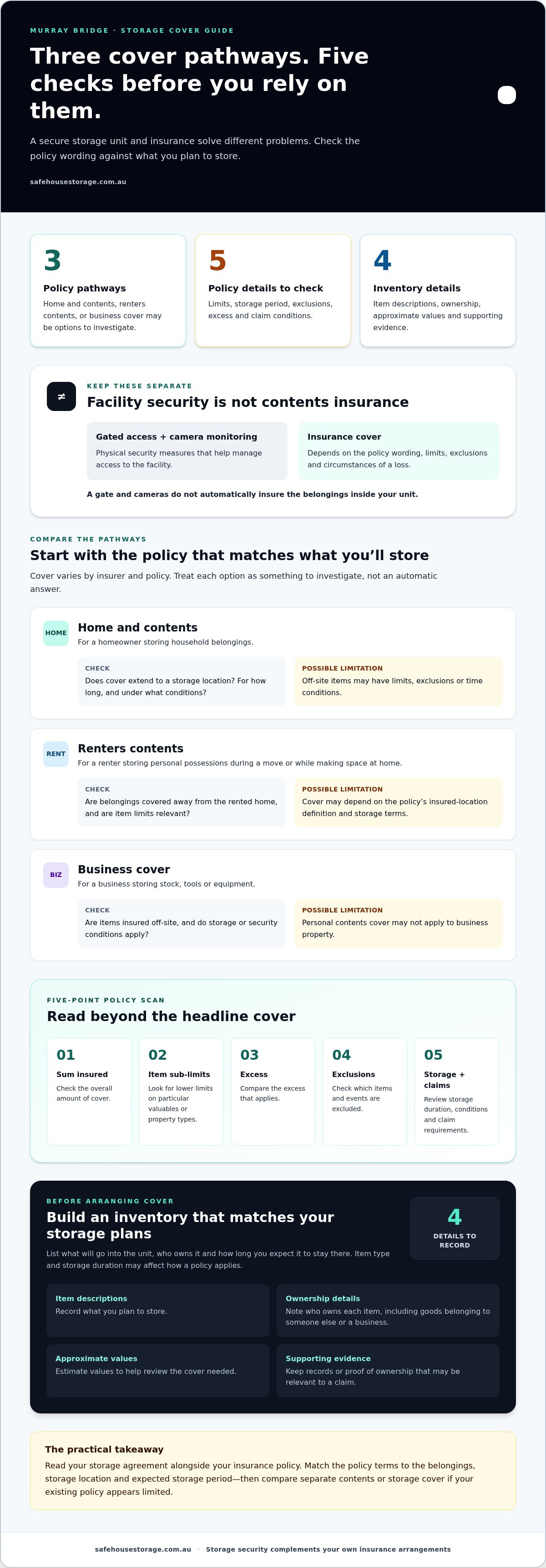
- Compare policy wording, not just the headline cover. Check the sum insured, item sub-limits, excess and exclusions.
- Prepare an inventory with item descriptions, ownership details, approximate values and supporting evidence before arranging cover.
- When considering self storage units Murray Bridge, treat facility security and insurance as separate parts of your storage plan.
- SafeHouse Storage offers small, medium and large self-managed units, with gated access and camera monitoring.
Storage unit insurance in Murray Bridge: what cover does it mean?
Does renting a secure unit mean your belongings are insured? Not necessarily. A gate and cameras can help manage access to a facility, but they don’t determine what an insurer will cover if your stored items are damaged, lost or stolen.
Storage unit insurance covers belongings kept in storage, subject to the policy wording, limits, exclusions and circumstances of the loss. The name of a policy doesn’t tell you which items or events are covered. Check the details in the policy documents.
Does a storage facility insure the items inside your unit?
Keep security and insurance separate. Gated access and camera monitoring are physical security measures. They don’t, by themselves, mean your belongings have insurance cover. Likewise, insurance doesn’t replace sensible steps to protect your items or explain what security a facility provides.
Read your storage agreement alongside your insurance policy. Look for wording about responsibility for stored goods and any insurance arrangements or conditions. Compare those details with your insurer’s policy wording, including requirements about the type of storage, how items are kept and how long they remain there. A general self-storage insurance overview can provide background, but your agreement and policy are the relevant documents for your situation.
For a closer look at practical security features in regional facilities, SafeHouse Storage’s regional secure self-storage guide explains how gated access and camera monitoring fit into a storage plan. These measures complement your insurance arrangements; they don’t determine what an insurer will pay.
What belongings and storage situations should you account for?
Start with what you plan to store, not just the unit size. Make a list of household, personal or business belongings and note who owns each item. Ownership can matter if goods belong to someone else or are part of a business. Item type and storage duration may also affect how a policy applies, so describe your plans accurately when reviewing cover.
In Murray Bridge, your reason for renting can help you identify what to check. During a move, you might store furniture, appliances and personal effects while your next home is being prepared. Renovations could mean keeping household contents out of the work area for a period. A local business storing stock may need to consider business cover rather than assume household insurance applies.
If you’re comparing self storage units Murray Bridge, list what will go into the unit and estimate how long it will stay there before arranging cover. This gives you a clearer basis for reviewing policy terms and matching your storage plans to your insurance needs.
How storage insurance options differ for Murray Bridge renters
Start by identifying which type of policy could suit the belongings you plan to store. Home and contents, renters contents and business insurance may each have conditions for items kept away from their usual location. Cover varies by insurer and policy, so treat each as an option to investigate, not an automatic answer.
Compare the policy’s storage terms, limits and exclusions before relying on cover. The policy schedule and wording matter more than the policy’s name.
Can home, renters or business insurance cover stored belongings?
Start with the policy you already hold. Check whether it covers belongings away from home or business premises, whether the storage location must meet particular conditions, and whether cover changes with the length of time items are stored. Look for limits on specific valuables or types of property as well.
Match the policy to what’s going into the unit. Household furniture and personal effects differ from business stock, tools or equipment, which may be treated under different terms. For general background on how storage cover can compare with home or renters insurance, see this guide to storage unit insurance. It’s an overseas resource, so use it for context rather than as a substitute for Australian policy wording.
| Option to investigate | Who might consider it | Questions to check | Possible limitation |
|---|---|---|---|
| Home and contents | A homeowner storing household belongings | Does cover extend to a storage location? For how long, and under what conditions? | Off-site items may have limits, exclusions or time conditions. |
| Renters contents | A renter storing personal possessions during a move or while making space at home | Are belongings covered away from the rented home, and are item limits relevant? | Cover may depend on the policy’s definition of the insured location and storage terms. |
| Business cover | A business storing stock, tools or equipment | Are those items insured off-site, and do storage or security conditions apply? | Personal contents cover may not apply to business property. |
When might a separate contents policy be worth comparing?
If an existing policy appears limited, compare it with a separate contents or storage policy before deciding. Look beyond the headline amount. Check which events are insured, the overall sum insured and any lower limit for particular items. Compare the excess, storage conditions and claim requirements, including any records or proof of ownership you may need.
For example, a Murray Bridge household storing furniture between homes and a small business keeping stock off-site may need to consider different policy terms. Write down the items, their owners and the expected storage period, then compare policy wording side by side.
Once you’ve worked out what needs storing, explore SafeHouse Storage units in Murray Bridge as part of your rental planning. Choose between small, medium and large units based on the belongings you plan to store, while assessing insurance separately.
Compare storage insurance policies before choosing cover
A large cover figure can look reassuring, but it doesn’t show how much protection applies to the items you’re storing. Compare the wording, not just the headline amount. The Product Disclosure Statement (PDS) and policy schedule set out the cover, conditions and limits that apply.
Use the checklist below to compare options. Examples are illustrative only. Insurers use different terms, so check each detail against current insurer documents and your own policy.
Which policy details deserve a close read?
Find the sections about belongings away from home or business premises, storage facilities, unattended locations and time limits. Check whether the policy requires particular storage conditions or treats certain items differently. A condition may apply to some belongings but not others, so read the relevant wording rather than assuming one rule covers everything.
Compare the sum insured with a realistic inventory and replacement-value estimate. The sum insured is the total amount selected for covered property, subject to the policy terms. Make sure it reflects the belongings you’re storing, not just what you remember owning. If you’re renting self storage units Murray Bridge, a room-by-room list can help you account for furniture, appliances and other items.
How can you compare excesses, limits and exclusions?
An excess is generally the amount you contribute towards a claim, but how it applies depends on the policy wording. An item sub-limit is a lower cap for a particular item or category, even if the overall sum insured is higher. Exclusions identify losses or situations the policy doesn’t cover. Conditions set requirements that may affect whether cover applies.
Compare the same details for every policy. Don’t assume an exclusion or storage condition in one policy appears in another. Check the current PDS and schedule, and note any unclear terms to discuss with the insurer before relying on the cover.
| Policy term | Question to check | Why it matters |
|---|---|---|
| Sum insured | Does the total reflect a realistic estimate of the covered belongings? | A low estimate may leave a gap between the amount selected and the value of your goods. |
| Item sub-limits | Are particular items or categories capped below the overall amount? | A lower cap may apply even when the total sum insured appears sufficient. |
| Excess | What amount would you contribute to a claim, and how is it applied? | It affects the amount payable to you under the policy. |
| Exclusions and conditions | Are there restrictions for stored items, location, duration or particular losses? | These terms can affect whether a specific claim is covered. |
Keep copies of the documents you reviewed and record the details relevant to your storage plans. This makes it easier to compare policies like for like and spot potential gaps before choosing cover.
How to get storage unit insurance: a practical checklist
Arranging cover is easier when you know what’s going into the unit and have the storage details to hand. Use this sequence to prepare, compare your information with the insurer’s requirements and keep useful records. Insurers can ask for different details and accept different forms of evidence, so use this as a preparation guide rather than a universal application process.
Prepare an inventory and estimate the value of stored items
Create a dated inventory before packing. Describe each item, note who owns it and estimate its current replacement value. Take photographs and keep available receipts, warranties or other ownership records. If you’re storing furniture for an extended period, practical preparation also matters. This long-term furniture storage guide covers useful points to consider before items go into storage.
- List what you plan to store. Group belongings by room or category, such as furniture, appliances, personal items, business stock or tools. Add enough detail to identify each item later. “Television” is less useful than the make, model and approximate age, if known.
- Record ownership and value. Note whether each item is yours, shared or owned by a business. Estimate what it would cost to replace rather than relying on what you originally paid. Make high-value belongings easy to identify in the list.
- Gather supporting evidence. Save dated photographs and any receipts or ownership documents you already have. Insurers don’t all require the same evidence, so check what your insurer accepts and what records it expects you to keep.
- Collect the storage details. Have the facility address, rental information and planned storage period ready. Give accurate details about the location and duration, along with any other information the insurer requests.
- Review the policy before relying on it. Read the completed schedule and relevant policy wording. Check that the insured belongings, storage location and dates match your plans. Note any item limits, conditions or exclusions that could affect cover.
Apply, keep records and review your cover
Use your inventory to answer the insurer’s questions consistently. If an item is especially valuable, flag it and check how the policy treats it rather than assuming the overall cover amount applies in full. Keep copies of your application, schedule, policy wording and supporting records somewhere easy to find if your storage arrangements change.
Review the details if you add or remove belongings, extend the storage period or change the location. Tell the insurer about relevant changes and follow its instructions for updating your policy. This helps keep your records aligned with what you’re actually storing.
Once you’ve prepared your inventory and reviewed the insurance questions, explore local self-storage options and plan a unit that suits your belongings.
Organise Murray Bridge storage with insurance in mind
A good storage plan brings together three decisions: what you need to store, which unit size suits it and how you’ll arrange insurance. Facility security and insurance serve different purposes. Security measures help manage access to a site, while your insurer’s policy documents explain whether your belongings are covered and under what terms.
Match your storage plan to the belongings and rental period
Start with your inventory. Estimate how much space the items need, taking into account how you’ll arrange them and whether you’ll need to reach particular belongings during the rental. A small unit may suit a limited number of items; larger loads may call for a medium or large unit. Consider the likely storage period too. A short gap between homes can involve different practical needs from storing furniture or business items for longer.
Keep insurance decisions separate from unit features. Gated access and camera monitoring don’t set your policy’s cover, limits or exclusions. Describe the storage location and expected duration accurately when reviewing your policy, then use the insurer’s wording to understand how those details affect your belongings.
If you’re storing a vehicle, the space and storage arrangements need separate consideration. If you’re planning to store a car, this Murray Bridge car storage guide offers relevant unit-size guidance. Review vehicle insurance terms with your insurer as well.
What to expect when arranging a SafeHouse Storage unit
SafeHouse Storage offers self-managed storage in Murray Bridge. The facilities are unmanned, gated and camera-monitored. These features are part of the storage setting, but they don’t insure the contents of your unit. Base your own insurance arrangements on your belongings, rental period and policy documents.
Choose from small, medium and large unit sizes. Use your item list to work out which option best fits what you’re storing rather than relying on a rough guess. Leave room to organise items in a way that suits how often you’ll need access to them.
You can arrange a unit through an online agreement or with assistance from local real-estate partners. Keep your rental details with your inventory and insurance records. That way, you can refer to the storage location and rental period when reviewing your cover.
Whether you’re comparing self storage units Murray Bridge or planning storage in Tenterfield, Lithgow or Coonabarabran, SafeHouse Storage offers small, medium and large self-managed units at unmanned, gated and camera-monitored facilities. Find a SafeHouse Storage unit to suit the belongings you plan to store.
Take the next step with a clear storage plan
Before you commit to a rental, turn your inventory into a simple plan. Decide what needs to stay accessible, estimate how much space your belongings need and note how long you expect to store them. Review insurance separately from your unit choice, and revisit your cover if your items, rental period or circumstances change.
If you’re weighing up self storage units Murray Bridge, SafeHouse Storage offers small, medium and large self-managed units at unmanned, gated and camera-monitored facilities. Arrange a unit through an online agreement or with assistance from local real-estate partners. These storage features support your plans, while your insurer’s policy documents determine your cover.
Choose a space that suits your belongings and how you plan to use it. Explore SafeHouse Storage options in Murray Bridge and take the next step with a clear storage plan.
Frequently Asked Questions
Does self-storage insurance cover everything I put in a unit?
No. Don’t assume a policy covers every item or event. Cover depends on the wording, insured amount, exclusions, item limits and storage conditions. A set of power tools, for example, may have different terms from ordinary household goods. Compare each inventory entry with the policy schedule and Product Disclosure Statement (PDS), then check which events are insured. Facility gates or cameras don’t change those terms or guarantee a claim outcome.
Can my home and contents insurance cover items in a Murray Bridge storage unit?
It may, but your policy wording and circumstances determine whether cover applies. Policies can limit cover away from home, set a storage period or treat certain belongings differently. If you’re arranging self storage units Murray Bridge, give your insurer the actual storage location and expected dates. Do the same for storage in Tenterfield, Lithgow or Coonabarabran. Review your schedule and PDS, then discuss your specific arrangement with your insurer.
Do I need separate insurance for a self-storage unit?
Not necessarily. Compare your existing home, renters or business policy with the items you’ll store and the conditions that apply. If you find a gap, such as a limit that doesn’t suit a particular item, compare other suitable cover options with an insurer. Separate insurance is worth considering, but it isn’t an automatic requirement. SafeHouse Storage’s security features don’t determine your insurance cover, so base your decision on the policy documents.
What information do I need to get storage unit insurance?
Insurers may ask what you’re storing, its approximate value, where the unit is and how long you expect to use it. A dated inventory, photographs and available receipts can help you prepare, even if an insurer doesn’t request every record. For example, list a laptop by make and model rather than writing only “electronics”. Requirements differ, so answer the insurer’s questions accurately and follow its instructions about information or evidence.
Are my belongings insured because a storage facility is gated and camera-monitored?
No. A gate and camera monitoring are security measures, not insurance for your belongings. They don’t establish which losses a policy covers or how its conditions apply. Treat site security and insurance as separate parts of your storage plan: consider the facility’s security features, then use your insurer’s documents to understand cover for the items you’re storing. Security measures can’t guarantee that loss won’t happen or that a claim will succeed.
What should I check in a storage insurance policy before applying?
Check the insured amount, excess, item sub-limits, exclusions, storage conditions and any time restrictions. Read both the PDS and policy schedule, looking for terms that apply when belongings are away from home or business premises. For instance, check whether a valuable item has a lower limit than the overall insured amount. If a phrase is unclear, ask the insurer to explain how it applies to your storage plans rather than relying on the headline figure.
Can business insurance cover stock or equipment stored in a self-storage unit?
It may, depending on the business policy, the property and the storage arrangement. Stock, tools and equipment may be treated differently from personal belongings, and limits or exclusions could apply. A tradesperson storing tools, for example, should check whether the policy wording addresses those items at an off-site location. Review the relevant business policy documents and discuss the specific unit, goods and storage period with your insurer. Don’t assume personal contents cover applies to business property.


