

Your move-out date is Friday, but your new home won’t be ready until next week. Where will everything go in between? Planning temporary storage for moving house Coonabarabran can bridge that gap, keeping selected belongings together while your home arrangements change.
When moving dates don’t line up, it’s easy to feel rushed. Working out how much space furniture, boxes and other belongings need can add to the pressure. A local self-storage unit gives you a place to keep items you don’t need straight away, rather than moving everything directly into your next home.
This guide explains what to put into storage, how to estimate the unit size you need, and what to consider when comparing storage formats. SafeHouse Storage offers small, medium and large self-managed units in Coonabarabran, with gated access and camera monitoring. Arrange a unit through an online agreement or with assistance from local real-estate partners. Use these steps to make the storage part of your move simpler and more organised.
Key Takeaways
- Plan storage around the gap between leaving one home and moving into the next, not just the moving truck’s schedule.
- Make an inventory and separate everyday essentials so you can estimate what needs storing and keep key items close at hand.
- Use your belongings list to compare small, medium and large unit options, rather than guessing based on the whole house.
- Compare self-storage and portable storage by considering where belongings will be kept, how you’ll manage access and how items will be moved.
- Use this guide to organise temporary storage for moving house Coonabarabran, from mapping dates to coordinating move day.
Why temporary storage for moving house in Coonabarabran can ease a date gap
A move doesn’t always happen in one neat handover. Settlement dates can shift, renovations may take longer than planned, or you may need to stay in temporary accommodation before your next home is ready. If you’re moving in, out or around Coonabarabran, temporary storage gives selected belongings a place to stay while you manage the change between homes.
Plan around when you’ll need each item, not only the day the removal truck arrives. Furniture and boxes you won’t need straight away can go into storage, while everyday essentials travel with you. This can make a temporary home easier to manage and keep the move organised. Storage gives belongings a place between homes, but settlement, renovation and transport arrangements still need their own plans.
When a gap between homes makes storage useful
A delay can leave you with belongings and nowhere suitable to put them in your next home. If you’re staying with family or in temporary accommodation, storing larger furniture, spare household items or boxes you won’t need straight away can help keep the space less crowded. Keep daily essentials separate and easy to reach during the in-between period.
Storage can also help if you’re moving in stages, such as shifting some belongings before the rest of the household is ready. A local self-storage unit in Coonabarabran can hold items between addresses, so you don’t have to move everything into your next home on the same day.
What temporary self-storage means for a household move
Temporary self-storage for moving house is a rented unit where you keep belongings until you’re ready to use them in your next home. You choose what to store and organise the items in the unit. This is different from a removal service, which transports goods between addresses. Storage is where belongings stay; transport is a separate part of the move.
SafeHouse Storage offers self-managed units in small, medium and large sizes in Coonabarabran. The facilities are gated and camera-monitored. For a household move, you can store items that don’t need to go straight to your new address and keep essentials with you. This gives you room to coordinate the move around your home dates.
For a broader overview of the storage format, What is self-storage? explains the general idea and common uses. For your move, start with a practical question: which belongings can wait, and which do you need on hand? Set aside daily essentials first, then identify furniture, seasonal goods and packed boxes that can stay stored until your next home is ready. This clear split can make both the temporary stay and eventual move-in easier to manage.
How to plan a Coonabarabran move around a temporary storage unit
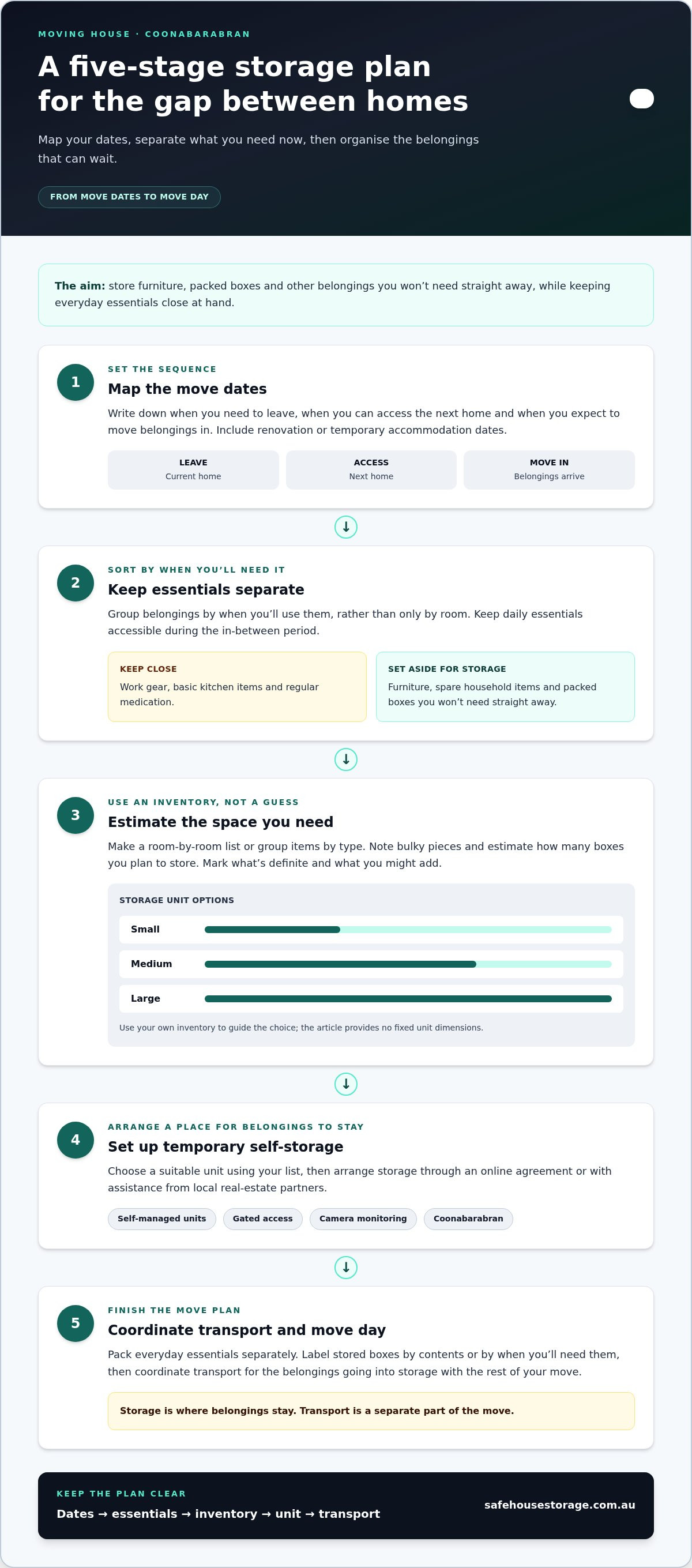
A little planning helps you avoid packing items you’ll need straight away or choosing a unit based on guesswork. Work through the move in order: set out the dates, sort belongings by when you’ll need them, estimate the space, arrange your unit, then coordinate transport for the stored items.
Quick planning checklist: Map the dates, list belongings by need, estimate space, arrange storage, then schedule the move.
Map the move dates and decide what needs storing
Write down when you need to leave your current home, when you can access the next one and when you expect to move belongings in. Include renovation or temporary accommodation dates. Then group items by when you’ll need them, rather than only by room. Keep daily essentials accessible and set aside less-used belongings for storage.
This makes it easier to decide what moves with you and what can wait. For example, keep work gear, basic kitchen items and regular medication close by, while furniture or packed boxes you won’t need during a temporary stay can go into storage. If a removalist is part of your plan, coordinate transport separately from your storage arrangement. The Australian Furniture Removers Association provides information about the furniture removals industry in Australia.
Estimate the unit size from an inventory
Before choosing a unit, make a room-by-room list or group items by type, such as boxes, furniture and appliances. Note bulky pieces and estimate how many boxes you plan to store. This gives you a clearer picture than estimating from the number of rooms alone. SafeHouse Storage offers small, medium and large storage units, so use your inventory to guide your choice.
For more focused sizing context, see the small storage unit hire guide. Use it as a prompt to review your own list, then count what you actually plan to store. If you’re still sorting belongings, mark what’s definite and what you might add. That way, you won’t base your plan on items that may not end up in storage.
Follow the plan from list to move day
Once you’ve mapped dates and estimated the load, arrange the unit and organise transport for the belongings going into storage. Pack everyday essentials separately so they don’t get mixed in with stored items. Label boxes by contents or by when you’ll need them, making it easier to find what should come out first when your new home is ready.
- Record the key dates for leaving, access and moving in.
- List belongings and separate immediate essentials from items to store.
- Estimate the space needed from your inventory and choose a suitable unit size.
- Arrange storage through an online agreement or with help from local real-estate partners.
- Coordinate the transport of stored belongings with the rest of your move.
With the sequence clear, you can organise a temporary storage for moving house Coonabarabran plan around your dates and belongings. If a self-managed unit suits your move, explore SafeHouse storage options as you work through the steps.
Self-storage or portable storage: which suits a Coonabarabran move?
Storage formats work differently. With self-storage, you rent a unit at a facility and organise how your belongings are loaded and managed. With portable storage, a container is delivered to a property for you to pack. The better fit depends on where you want belongings kept and how storage fits with your transport plans.
For temporary storage for moving house Coonabarabran, compare the practical details instead of assuming one format is automatically simpler. Consider where your items will be stored, how you’ll manage access and how they’ll travel from your current home to storage, then to your next address.
When a self-managed storage unit may fit the move
A self-managed unit can suit households that want to keep belongings together between addresses. You organise the items going into storage, load them into the unit and manage them while they’re stored. SafeHouse Storage offers small, medium and large units in Coonabarabran. Its facilities are unmanned, gated and camera-monitored, and customers manage their own stored belongings at the facility.
What to weigh up when comparing storage formats
Compare each arrangement with your moving plan. A rented unit keeps belongings at a storage facility; a portable container is delivered to a property for loading. Consider which location works for your move, who will handle loading and unloading, and how you’ll coordinate transport between addresses.
- Where items stay: In a self-storage unit, belongings are kept at the facility. With a portable container, they’re packed into a container delivered to a property.
- How you manage items: With a self-managed unit, you organise loading and access to your belongings. A portable-container arrangement centres on packing into the delivered container.
- How transport fits: Consider how items will get to and from the storage location and how that fits with the rest of your move.
For example, if your belongings are already being transported to a local storage facility, a unit may fit the sequence you’ve arranged. If your plan centres on packing at a property, a portable container is a different format to consider. Choose based on your moving arrangements, not just the label used for the storage option.
SafeHouse provides self-managed storage units. The unit is where your belongings are kept, while arranging how they reach it remains part of your household’s move plan. A broader regional moving storage guide can also help you consider how storage fits into a wider transition.
Before choosing a format, picture the whole journey: where items are now, where they’ll be stored and how they’ll reach the next home. Compare that sequence with how you want to manage loading and access. This helps you choose an arrangement that matches your move without treating storage and removal transport as the same service.
A practical checklist for temporary storage during a Coonabarabran move
A clear checklist helps keep the storage part of a move manageable. Work out which belongings need storing, how much space they may take, how you’ll organise the unit and how items will get there. If you’re arranging temporary storage for moving house Coonabarabran, these steps turn a rough plan into a practical sequence.
Before arranging a unit
Start with your move dates. Note when belongings need to leave your current home and when you expect to move them into the next one. Make an inventory of what you plan to store and mark the items you’ll need to keep accessible. Use the list to consider whether a small, medium or large unit best suits your belongings.
- Dates: Record the key move-out and move-in dates, including any changes that may affect when belongings need storing.
- Belongings: List the furniture, boxes and other items you intend to store. Separate everyday essentials from items that can remain packed.
- Unit size: Use the inventory to estimate the space needed, rather than sizing the unit based on your whole home.
- Agreement: Decide how you’ll arrange the unit, either through an online agreement or with assistance from a local real-estate partner.
- Move-day coordination: Plan how the stored belongings will be transported and fit that into the wider move schedule.
Arranging storage and coordinating move day
SafeHouse customers can arrange a storage unit through an online agreement or get assistance from local real-estate partners. Once you’ve identified the belongings and likely unit size, add storage to your moving schedule. Keep transport planning separate from the storage arrangement: work out how items will reach the unit and when they’ll be moved to your next home.
On move day, keep your inventory handy and separate essentials from items intended for storage. If you’re storing furniture, plan how it will be handled during the time between homes. A long-term furniture storage guide can offer useful background for items that will remain stored beyond the immediate move.
Before finalising your plan, review the checklist: dates, belongings, unit size, agreement and transport coordination. Each part has a place in the sequence, helping you keep the move organised when the day gets busy.
Ready to organise the storage part of your move? Arrange a SafeHouse storage unit online or with assistance from a local real-estate partner.
Arrange temporary storage for your move with SafeHouse in Coonabarabran
If your home dates don’t line up, a storage unit gives selected belongings a place to stay between addresses. SafeHouse Storage offers self-managed units in Coonabarabran in small, medium and large sizes. The facilities are unmanned, gated and camera-monitored, giving you a local storage option while you organise the next stage of your move.
What SafeHouse storage offers during a move
SafeHouse provides storage space for you to manage. You decide which belongings go into the unit and organise their transport there. This arrangement can suit a move where furniture, packed boxes or other household items need to remain stored until you’re ready for them at your next home.
Choose a unit size based on the items you intend to store. A short inventory helps you distinguish a few selected belongings from a larger household load. SafeHouse offers small, medium and large unit options, so consider the furniture and boxes on your list rather than relying on a rough estimate of your whole home.
The facility is unmanned, with gated access and camera monitoring. As storage is self-managed, you organise your belongings and coordinate their transport between your home and the unit.
Take the next step with a local storage plan
Before arranging storage, bring together three basics: your expected move dates, a list of what you want to store and an estimate of the space those items need. This gives you a clearer starting point when choosing between small, medium and large storage units. It also helps you decide which essentials should stay with you while other belongings are stored.
Customers can arrange a SafeHouse unit through an online agreement or get assistance from local real-estate partners. Choose the route that suits how you prefer to organise storage. Then coordinate transport and timing as separate parts of your plan, so you know how belongings will reach the unit and when you’ll need them again.
For temporary storage for moving house Coonabarabran, a local self-managed unit offers a practical way to keep belongings together while home arrangements change. SafeHouse’s range of unit sizes gives you options to consider for the items on your inventory, and the facility has gated access and camera monitoring.
Once you’ve considered your dates, belongings and likely unit size, explore SafeHouse storage in Coonabarabran.
Make your next move with a clearer plan
Once you know your dates, turn them into a simple moving timeline. Keep it with your household notes and update it if settlement, renovation or access plans change. This gives everyone involved the same schedule and lets your storage plan adjust with the move instead of becoming a last-minute task.
Temporary storage for moving house Coonabarabran can give you more room to manage the transition at a sensible pace. Before arranging a unit, review the belongings you’re setting aside and when you expect to need them again. A clear plan makes the next steps easier to organise.
Explore the local option that fits your move and choose how you’d like to arrange it. Explore SafeHouse storage in Coonabarabran and start planning the space you need for the change ahead.
Frequently Asked Questions
How long can I use temporary storage when moving house?
Temporary storage for moving house Coonabarabran can cover a short gap or a longer transition. SafeHouse offers short-term and long-term self-storage rentals. Plan around when you need to leave your current home, the expected handover and when you can move into the next place. Let your schedule and rental arrangement guide how long you store belongings.
What size storage unit do I need when moving house?
Start with an inventory of the belongings you plan to store, then group items by room or type, such as boxes, chairs and larger furniture. The amount and shape of your furniture can affect how much space the load needs. SafeHouse offers small, medium and large units. If you need a starting point, compare your list with a storage size guide before arranging a unit.
Can I arrange a SafeHouse storage unit online?
Yes. SafeHouse customers can arrange storage space through an online agreement. Local real-estate partners can also assist. Before starting, note your expected move dates, list the belongings you want to store and estimate which unit size may suit them. Read the agreement details so your plan reflects the rental terms that apply to your move.
Is SafeHouse Storage in Coonabarabran staffed?
No. SafeHouse facilities in Coonabarabran are unmanned, so customers manage their own stored belongings. The facility is gated and camera-monitored. Keep an inventory of what you’ve stored so you can track your items and plan what you’ll need to retrieve.
Can I store business belongings while moving premises?
Yes. SafeHouse units are available for self-managed residential and commercial storage. If your business is changing premises, list the items that can be stored and set aside anything needed for daily work. This helps you plan what should stay accessible during the move. SafeHouse also serves customers in Murray Bridge, Tenterfield and Lithgow, as well as Coonabarabran.
Does SafeHouse provide packing boxes or climate-controlled storage?
SafeHouse provides self-storage unit rentals. Plan your packing separately and prepare belongings before moving them into a unit. Sort items by when you’ll need them and label boxes clearly, making it easier to find essentials as you settle into your next home.
How do I choose between a portable container and a storage unit?
Compare where belongings will be kept and how each option fits your transport plan. Portable storage services may deliver a container to a property, while a self-storage unit is rented at a facility and managed by the customer. SafeHouse provides self-managed units. Consider how you’ll move items to storage, where you want them held and how you’ll coordinate their onward trip to your new address.


