

A taller stack isn’t automatically a better use of your storage unit. If you’re wondering how to stack boxes in a storage unit without building a wobbly tower or burying things you’ll need, plan the loading order before you start. Heavy, sturdy boxes belong low, and a clear route matters more than squeezing in another layer.
It can be hard to decide which boxes should go at the bottom, especially when they’re different sizes or contain fragile belongings. A stack that leans or shifts can damage items, while filling every gap can make it difficult to reach what you need. Check the condition, weight and shape of your boxes before deciding where they belong.
This guide explains how to organise your boxes, build stable stacks and leave practical access to stored items. You’ll learn what to load first, where to place lighter or awkwardly shaped boxes, and how to check each stack as you build it. The aim is a simple loading order you can follow on moving day, not a race to reach the ceiling.
Key Takeaways
- How to stack boxes in a storage unit starts with deciding what goes where, not filling every gap.
- Choose sound, similar-sized boxes where possible, and pack them so the contents don’t shift or make the box difficult to lift.
- Place heavier, sturdier boxes low and build manageable stacks that leave access to belongings you may need.
- Group boxes by room or purpose so you can find and retrieve them more easily.
- SafeHouse Storage offers small, medium and large self-managed units in Murray Bridge, Tenterfield, Lithgow and Coonabarabran.
How to stack boxes in a storage unit starts with a plan
A full storage unit is only useful if stacks stay stable and you can reach the belongings you need. Before unloading, sort boxes into groups and decide where each group will go. Plan for heavier items near the bottom, frequent-use belongings near the entrance, and a clear route between them.
A simple layout can save time during loading and reduce the need to reshuffle later. It also helps you use the available space without treating height as a target. Each stack should suit the strength and shape of its boxes. If the base looks uneven or a box bows under weight, rearrange it before adding another layer.
Sort and group boxes before loading
Group boxes by room, contents or how soon you’ll need them. Use clear labels such as “kitchen”, “books” or “winter clothes”. Also set aside fragile items, heavy loads and awkward shapes, as they may need different positions even if they belong to the same room.
Identify essentials you may need during storage, such as a document folder or a few household items. Keep these out of deep storage zones and note where they’ll go. This makes it easier to plan access before the unit starts filling up.
Sketch a simple storage-unit layout
You don’t need a detailed floor plan. A quick sketch or a few notes can show the entrance, the route towards the back, and the places for frequently used and rarely needed belongings. Put occasional-use items deeper inside and keep things you may need sooner closer to the entrance.
Leave enough room to reach each group without moving unrelated stacks. Think in terms of storage zones, not just gaps to fill. Pallet racking systems organise stored goods by position and access. The same basic idea can help you plan a smaller unit, even without shelving.
Use the layout to decide what to carry in first. For example, if you’ll want the kitchen boxes soon, don’t put them behind furniture or a deep stack. Keep the route clear as you work, and compare the actual load with your sketch as each zone takes shape. If a group takes up more room than expected, adjust the plan before adding more boxes.
- Place items planned for the deepest part of the unit first.
- Keep the route from the entrance open while loading.
- Build each group where it can be reached without shifting unrelated boxes.
- Pause to check that the layout still matches your plan before adding more.
Sorting and sketching are practical first steps in how to stack boxes in a storage unit without making access an afterthought. A clear plan helps turn a crowded load into an arrangement you can understand and use.
Choose and prepare boxes for stable storage-unit stacks
The shape and condition of a box affect how securely it sits in a stack. Firm boxes with similar dimensions are easier to line up than cartons with crushed corners, bulging sides or sagging bases. Check each box before loading, and don’t use a damaged carton to support another load.
Pack boxes so their contents don’t shift, while leaving enough room to close them properly. An overfilled box can bulge and become difficult to stack. An underfilled one may collapse if its contents move. Aim for a firm, even shape, and keep heavy objects separate from delicate items. Preparing boxes this way makes it easier to stack them without creating unstable layers.
Match each box to its contents and weight
Use smaller boxes for dense belongings such as books, and larger boxes for light, bulky items such as doonas or cushions. Spread the contents evenly rather than loading one side. Cushion fragile items so they don’t knock against each other, and avoid placing heavy objects in a box with delicate belongings. Lift each box carefully before stacking. If it feels awkward or too heavy to handle with control, repack it into smaller loads.
Close, label and prepare boxes for loading
Close each box securely, then check that its base, corners and sides feel firm. Write labels on more than one visible side so you can identify the box when it’s packed beside others. Use clear room or contents descriptions, and mark fragile boxes or belongings you’ll want to reach soon. These labels help you position boxes during loading and find the right group later.
Before adding a box to a stack, check for torn seams, damp patches, loose flaps and sides that bow under pressure. If the box is sound but its contents move when you gently tilt it, reopen it and adjust the packing. Keep unusual shapes, such as a long lamp carton, separate from regular boxes so they don’t create gaps or unstable contact points.
For a broader look at safe warehouse handling, the U.S. Army’s Warehouse safety and stacking techniques offer useful context. A home storage unit isn’t a warehouse, but the basic principle still applies: use a firm base and don’t let a stack become unstable just to gain height.
- Sound: no crushed corners, torn seams or soft, sagging panels.
- Balanced: contents are spread evenly and don’t shift around.
- Manageable: you can lift and place the box with control.
- Identifiable: labels can be read from more than one side.
Preparing boxes carefully also makes moving belongings into a self-managed unit more straightforward. SafeHouse Storage’s self-managed units provide space to organise belongings during a move or home project.
Build stable box stacks without crushing or blocking access
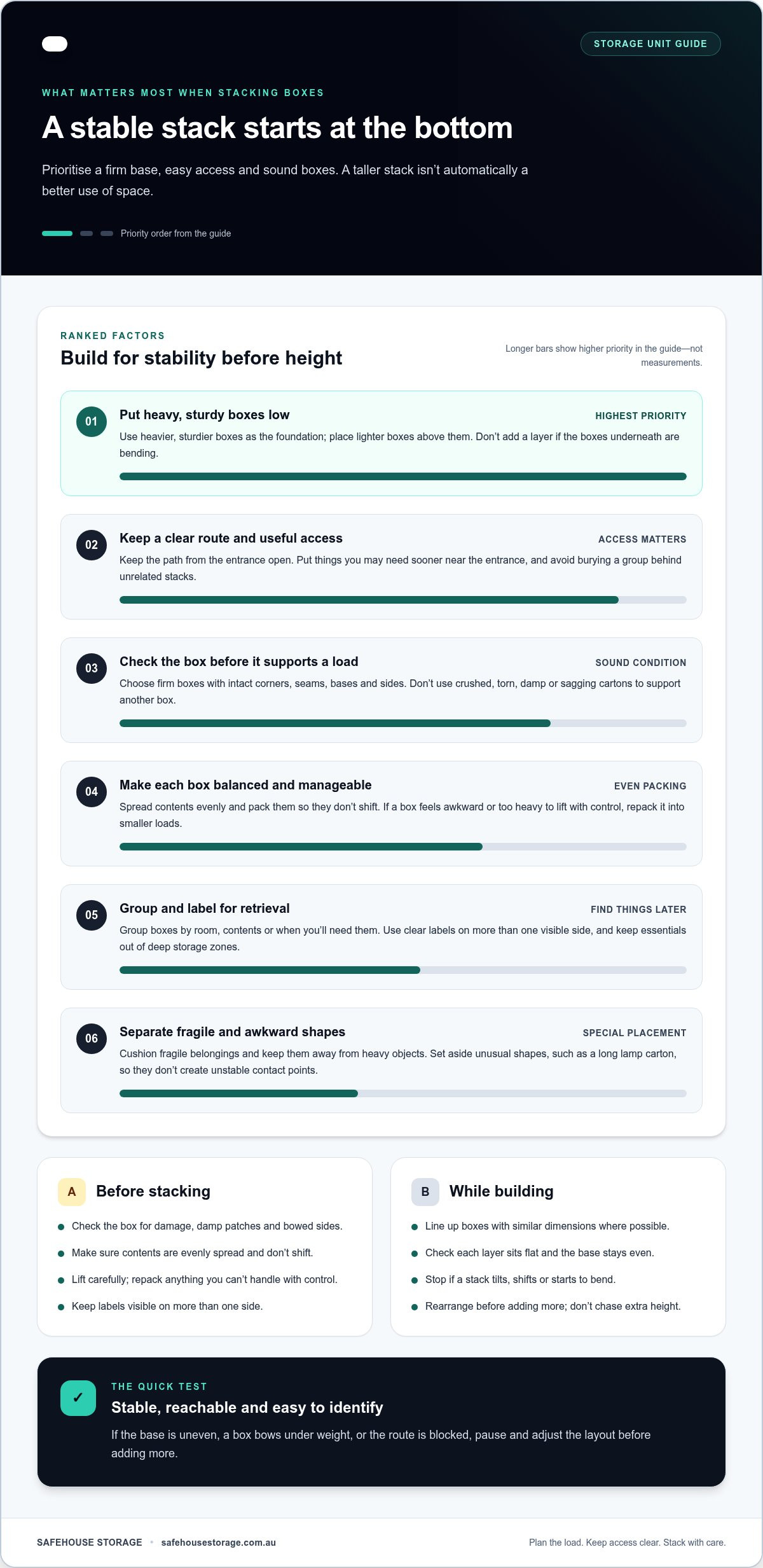
A safe stack is stable and manageable, not simply as tall as possible. Put heavier, sturdier boxes at the bottom and lighter ones above. Check that each layer sits flat and that the boxes underneath aren’t bending under the load. If the stack tilts or shifts, stop and rearrange it before adding more.
Keep box edges aligned where possible. Boxes that sit squarely on one another are less likely to slide than a pile with corners jutting out in different directions. Don’t use an uneven box to prop up another, or lean boxes against a stack that already feels unsteady. A neat-looking pile still needs a firm base.
Put weight at the bottom and balance each layer
Start with the strongest boxes. Place heavier contents low and spread them across the base instead of concentrating the load on one carton. Add lighter boxes above, centring each one over the support below. Move any box that overhangs an edge, shifts when placed or presses on a weak spot. The goal is an even load, not a tightly packed tower.
Set a sensible stack height and protect access
Choose a height you can build and retrieve from without reaching over an unstable pile. There’s no fixed number of layers that suits every box. Stop when the stack remains steady and you can handle the top box with control. Don’t climb on boxes to reach belongings, and keep the route clear so you can reach items stored further inside.
Check each new layer before moving on. Look at the stack from the front and side. Are the boxes level? Does the stack lean, or do any cartons bow under the weight? A small adjustment is easier than rebuilding a tall pile later. If anything feels unsafe to reach or place, take boxes down and rearrange them.
Pay attention to differences between cartons. A wide, firm box may support a lighter one, while a narrow or softened box can become a weak point under extra weight. Keep awkward shapes from pushing neighbouring boxes out of line. Don’t force different-sized boxes into gaps. Leave the space open or start a separate stack.
- Keep the base firm: put the strongest boxes low and distribute weight evenly.
- Check each layer: centre boxes and keep edges as aligned as their shapes allow.
- Watch for warning signs: stop if a box bows, a pile tilts or anything shifts.
- Keep access safe: leave a route through the unit and don’t climb on boxes.
Build a stack one layer at a time, checking that it remains steady and within easy reach. Leave room to move around it, and rearrange the boxes if the pile starts to lean or shift. That’s the practical answer to how to stack boxes in a storage unit without crushing belongings or making them difficult to retrieve.
Load a storage unit in a practical order
A planned loading sequence can save you from shifting the same belongings more than once. Follow your layout: put rarely used items deeper inside, build each stack where it will stay, and check that you can still move through the unit. Keep boxes together by room or purpose so the finished arrangement makes sense at a glance.
Work from the back towards the entrance. Bring in only what you can place properly, rather than unloading everything into a heap and sorting it later. A clear route gives you room to carry boxes and adjust a stack as it takes shape.
Load from the back of the unit towards the entrance
Start with belongings you’re unlikely to need soon, following your layout. Place each item in its intended position and build its stack there, rather than making a pile near the door that you’ll have to move. Keep the route from the entrance clear. If a bulky item changes the available space, pause and adjust your plan before loading the next group.
- Place rarely needed belongings in their planned spots at the back.
- Build and check each stack where it will remain.
- Bring in the next group, keeping boxes with the same room or purpose together.
- Reserve a clear route to the entrance and the stored items beyond it.
This order makes the layout easier to follow later. For example, keep bedroom boxes together instead of spreading them across several stacks. A predictable location makes it simpler to retrieve the whole group. As you load, turn labels towards the route where practical, so you can read them without moving boxes.
Keep essential boxes easy to reach
Place boxes you’ll need soon near the entrance, where they’re visible and easy to retrieve. Keep them on a stable, reachable part of a stack, not perched above heavier boxes or squeezed into a spot where they could shift. If you’ll need an item regularly, give it a clear place instead of burying it behind belongings you rarely use.
Before you finish, walk through the unit and check that the route is open, labels are readable, and no stack leans into a walkway or blocks another group. Look for boxes that shifted during loading and adjust them while you can still reach them. Keep the entrance and access points unobstructed.
- Route: Can you move from the entrance towards the back without shifting boxes?
- Stacks: Are they steady, with no boxes leaning into a path?
- Access: Can you reach the items you’re likely to need soon?
- Labels: Can you identify each group from the clear route?
A final check turns your loading plan into a practical setup, not just a packed unit. SafeHouse Storage offers self-managed storage units for belongings you’re organising during a move or home project. You can arrange a SafeHouse Storage unit.
Make box stacking easier in a SafeHouse Storage unit
A workable layout needs room for boxes, bulky belongings and the access route you plan to keep clear. Before choosing a unit, make a rough inventory. Note how many groups of boxes you have, which items take up more floor space, and what you may need to reach during storage. This gives you a more useful starting point than estimating by box count alone.
Don’t assume a smaller unit will work just because you can stack higher. Safe stacking depends on the strength and shape of your boxes, and you’ll need room to reach stored belongings without shifting piles. Include furniture and awkwardly shaped items in your estimate, along with the route you plan to keep clear. For more guidance on planning unit size, see this small storage unit hire guide.
Match your planned stacks to the space you need
Think through the layout before arranging storage. Group boxes by room or purpose, set aside items you’ll want to reach, and decide where larger belongings will sit. A unit may fit the total contents but still leave too little practical access. Choose between a small, medium or large unit based on the belongings and layout you need, not on a plan to build the tallest possible stacks.
A quick sketch can help. Mark the entrance, route through the unit, places for bulky items and areas for box groups. If the plan only works by blocking access or stacking beyond a comfortable, stable height, rethink the space you need. Aim for a layout that supports stable stacks and leaves belongings manageable to reach.
Arrange regional self-storage with a clear plan
SafeHouse Storage has self-managed storage units in Murray Bridge, Tenterfield, Lithgow and Coonabarabran. Its facilities are unmanned, gated and camera-monitored. You can arrange a unit through an online agreement or get help with arrangements through local real-estate partners.
Keep your inventory and layout sketch handy before moving in. They can guide where each group goes and help you avoid making decisions on the fly as the unit fills. Start with belongings planned for deeper storage, build each stack in its intended spot, then keep items you may need sooner accessible. If the contents or layout change, adjust the plan rather than forcing boxes into an unsafe arrangement.
With a suitable amount of space and a sensible loading order, a self-managed unit can help organise belongings during a move or home project. Explore SafeHouse Storage options.
Set yourself up for an easier move-in
Before moving day, think about how you’ll use the unit once everything is stored. What might you need to retrieve first? Which belongings can stay packed away until the end of your move or project? Answering these questions can help you decide what to bring in and where to put it.
Keep a short inventory on your phone or with your moving notes. Add a reminder beside any box you’ll want to find quickly. When you arrive, you’ll have a reference instead of relying on memory among a roomful of cartons. A little preparation makes how to stack boxes in a storage unit easier to put into practice, even if your plans change.
Choose a storage space that suits the belongings you’re organising, then use your layout to guide the loading order. Explore SafeHouse Storage options for your move or home project. With a clear plan in hand, you can get started with confidence.
Frequently Asked Questions
How do you label boxes for a storage unit?
Write a clear room and contents description, such as “main bedroom, linen” rather than “miscellaneous”. Add a brief note if the box is fragile or you’ll need it soon, then write the label on more than one visible side. Keep a simple list of labels and key contents outside the unit, such as on your phone. That way, you can check what’s inside without opening boxes or searching through stacks.
Can you stack plastic storage tubs on cardboard boxes?
You can, if the tub has a broad, flat base and the carton below is firm enough to support it. A heavy tub or one with an uneven base may shift or press down on the cardboard. For example, a light tub of spare bedding may sit more securely than a tub filled with tools. Keep heavier containers low, check that each layer sits flat, and take the stack down if it wobbles.
Should you put clothes in boxes or bags for storage?
Boxes are often easier to stack and label, while soft bags can slump or shift when piled. Choose a clean, dry container that suits the clothing and can be closed securely. A box can work well for folded jumpers, while a bag may suit lighter items that won’t be crushed. Keep containers manageable to lift, and store clothing away from anything that could leak or stain it.
What should you do before moving boxes into a storage unit?
Before loading, sort belongings and group boxes by room or purpose. Set aside anything you may need soon, then check that boxes are closed, labelled and comfortable to lift. A quick layout sketch can show where rarely used belongings will go and how you’ll reach essentials. Planning how to stack boxes in a storage unit before moving in can prevent last-minute reshuffling, whether you’re organising a move in Murray Bridge or a home project elsewhere.
How do you keep track of boxes in self-storage?
Give each box a clear label and, if you have several similar cartons, add a simple number. Keep a list with each number, a short contents note and its location in the unit, such as “back left” or “near entrance”. This can be useful in Murray Bridge, Tenterfield, Lithgow or Coonabarabran when you’re storing items during a move. Update the list whenever you retrieve a box or change the layout.
Can you stack boxes against a storage-unit wall?
Don’t rely on a wall to hold up a leaning or unstable pile. Build the stack on a firm base and make sure each layer is balanced, with no box pushing out or slipping. Leave enough room to read labels and retrieve belongings where needed. If cartons bow, the stack tilts or anything shifts as you add a box, lower the pile and rearrange it rather than using the wall as support.


